
This is exactly what I’ve been wanting to write about push notifications for the iPhone.
512 Pixels
The Problem of Thin Clients
Google’s announcement of Chrome OS has brought the idea of the thin client back into focus. Simply put, a thin client is a computer workstation that runs very limited software—sometimes just a browser—to connect the user to a server (or the cloud) that does all the heavy-lifting.
Thin clients offer several advantages that make them a good solution in some cases. Thin clients mean cheaper hardware, lighter network traffic and a uniform user experience across machines.
Of course, the thin client requires a server or cloud service on the other end. In Google’s case, their services include email, word processing, photo galleries, news and more. Often in professional environments, the clients (especially Windows-based clients) often include a handful of apps—usually Microsoft Office—with everything else on the server, with no way to install other applications. Hence, if users need a service that’s not on the local machine, they have to use a web application.
The problem of thin clients—and most web applications—is that they aren’t rich.
A recent example is the iPhone OS. Before the iPhone SDK, Apple told developers to build web apps. Basically, web apps are websites formatted to fit the iPhone screen and optimized to use multi-touch. Today, a year after the App Store has opened, they’re tons and tons of apps written in Cocoa that run natively on the iPhone, doing things that were impossible to do in MobileSafari. Before the App Store, Twitter users had to use sites like m.twitter.com, Hahlo, or Logpost. Compared to iPhone clients like Tweetie, Twitterrific and Birdfeed, those web apps are piles of crap.
The browser—even the best browsers in the world—just can’t pull off the same tricks real, OS-based applications can.* Take iLife for example. No web app can match iMovie or iPhoto’s power. Even simple things like OS X’s built-in mail application is nicer and fuller than Gmail. I’m not sure people are ready to give up the niceties that come with having a real OS under their applications. And until that changes, I’m not sure Chrome OS—or any other thin clients—will be a threat to any desktop OS.
———-
*Of course, HTML 5 will add all sorts of goodies, and WebKit-based
browsers will support it, but it’s still not the same.
Even More on Eric Schmidt
Because Google’s new Chrome OS would compete with Apple’s own computer software, Schmidt said on Thursday he would talk to the Mac computer maker about whether he should recuse himself from Apple’s board.
“I’ll talk to the Apple people. At the moment, there’s no issue,” Schmidt told reporters at a Sun Valley media and technology conference organized by boutique investment bank Allen & Co.
While Google and Apple compete directly or indirectly in a number of areas – the most obvious being the smartphone market – Google’s announcement this week that it will launch an operating system raised more questions about the relationship between their boards.
OS 9 Gets New Browser
OS 9—killed off several years ago— has been almost forgotten. But almost.
Enter Classilla, a project to get a modern port of Mozilla’s browser running on OS 9:
Classilla is bringing back web browser support to your classic Macintosh – built on WaMCoM, a port of Mozilla to classic Macintosh systems, using the same technology underpinning the popular Firefox browser. It’s completely free and it’s open source, and it’s standards-compliant. Use it without cost or restriction; or, if you’ve got the skills, hack it and make it your own. Classilla brings your wonderful old Power Macintoshes back to life and back online.
But before you go dust off your old clamshell iBook, read the fine print:
Classilla doesn’t replace, and isn’t designed to replace, the excellent iCab. While it will of course replace Mozilla and WaMCoM if that’s what you’re using, and has much better support than Internet Explorer and Netscape Navigator, there are still many sites you may need to use a combination of browsers to view. Classilla is much faster, and its JavaScript is much more robust, but iCab still has the edge for CSS and layout. And at least for awhile that’s how it’s going to be.Support those who still support the classic Mac; if you’re serious about using the Web on an OS 9 system, let Alexander know by registering iCab. Then use Classilla where you can, and iCab where you must, and get all your bases covered.
Pretty cool.
TechRestore Records 3GS Disassembly
The best part? It’s in stop motion:
More on Eric Schmidt
From an open letter written by CNET’s Tom Krazit:
When Google announced plans to develop Android, a smartphone operating system that competes with Apple’s iPhone OS for consumer and developer attention, you said you would recuse yourself from any discussions about the iPhone during meetings of Apple’s board. You reiterated that stance in May after reports emerged that the Federal Trade Commission had raised an eyebrow at your presence on both boards, and when asked if you recuse yourself from any other topics at Apple meetings, you answered, “Not that I recall.”
So, do you now plan to recuse yourself from any board meetings in which Mac OS X development is discussed? You’re also not a member of the three main committees on Apple’s board: Audit and Finance, Compensation, and Nominating and Corporate Governance. Is the iPod the only product at Apple that you’re now qualified to oversee?
A Brief Look at Apple and Google’s Ever-Growing List of Competing Products
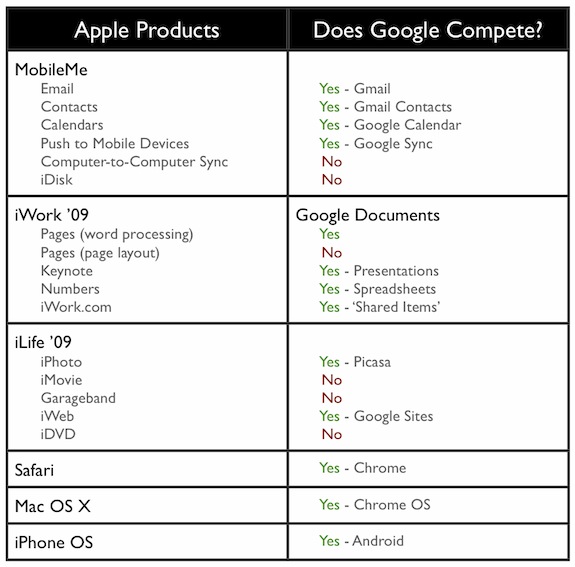
If there are any products I missed, let me know.
This makes me wonder how Google’s Eric Schmidt can continue to sit on Apple’s board of directors.
Chrome OS
Google dropped a bombshell late last night:
It’s been an exciting nine months since we launched the Google Chrome browser. Already, over 30 million people use it regularly. We designed Google Chrome for people who live on the web — searching for information, checking email, catching up on the news, shopping or just staying in touch with friends. However, the operating systems that browsers run on were designed in an era where there was no web. So today, we’re announcing a new project that’s a natural extension of Google Chrome — the Google Chrome Operating System. It’s our attempt to re-think what operating systems should be.
The idea behind this is pretty interesting. Google sees the OS as only a vehicle to get the user online. By making the browser the primary component of the OS, it propels users to the Internet—and Google’s online services—faster and easier. It makes perfect sense for netbook users, who use their machines for Internet-based applications (for the most part) already.
App Store One Year Old
I can hardly believe it’s only been a year. In that short time, developers have gone from writing web apps—basically web pages formatted to better-fit the iPhone’s screen—to full blow, cocoa-based applications. And the applications are good. Sure, they’re some crappy apps out there, but I am surprised weekly by something that appears in the catalogue that suddenly changes how I go about my day. And as time goes on, the apps keep getting better.
But as blinding as the bright spots are, the App Store has been marred several times by ridiculous app rejections, slow responses to developers from Apple and even slow payment for developers’ sales. Apple needs to address these issues for developers to remain happy. (Not that I think devs will ever leave the platform, as long as money continues to be made hand-over-fist.)
But even with the issues, OS X still remains the mobile application platform . And as Apple’s market share continues to grow, so will the App Store.
White iPhones Selling Out?
Apple has been having trouble keeping the entry-level white iPhone in stock since the new 3GS went on sale two and a half weeks ago. But as of Tuesday morning, it has all but disappeared.
The 16 GB model — apparently the most popular — is out of stock in the 30 of the 41 states in which Apple has stores, as well as in the District of Columbia.
It’s available in only one of California’s 45 Apple Stores, 1 of 9 in Massachusetts, 1 of 7 in Illinois, 1 of 6 in Virginia and 1 of 3 New York City.
It’s not clear whether demand for the white 16GB model is unusually high, or if Apple just isn’t making enough of them.
As an owner of a new white iPhone 3GS, I can say—unscientifically—that I am in the minority. I think the shortage is simple: Apple makes more back phones cause the sell better. I don’t see the mystery.
Paste and Match Style
This tip deserves to be in the OS X hall of fame. I’ve implemented it on both my Macs already.