The Power Mac 4400

In November 1996, Apple released the Power Macintosh 4400 with a starting price of $1,725. Also sold as the Power Macintosh 7220, it’d be easy to write this machine off as just another grain of sand on the beige beach that was Apple’s product line in the 1990s. I mean, just look at this thing, pictured here with an Apple-branded CRT:

Power Mac 4400

If you were around the Mac line in the late 1990s, your blood probably ran cold when you saw the 4400’s name in the above headline.
Continue reading ⇢

Sponsor: Unite 5 Turns Web Apps Into Supercharged macOS Apps⇢

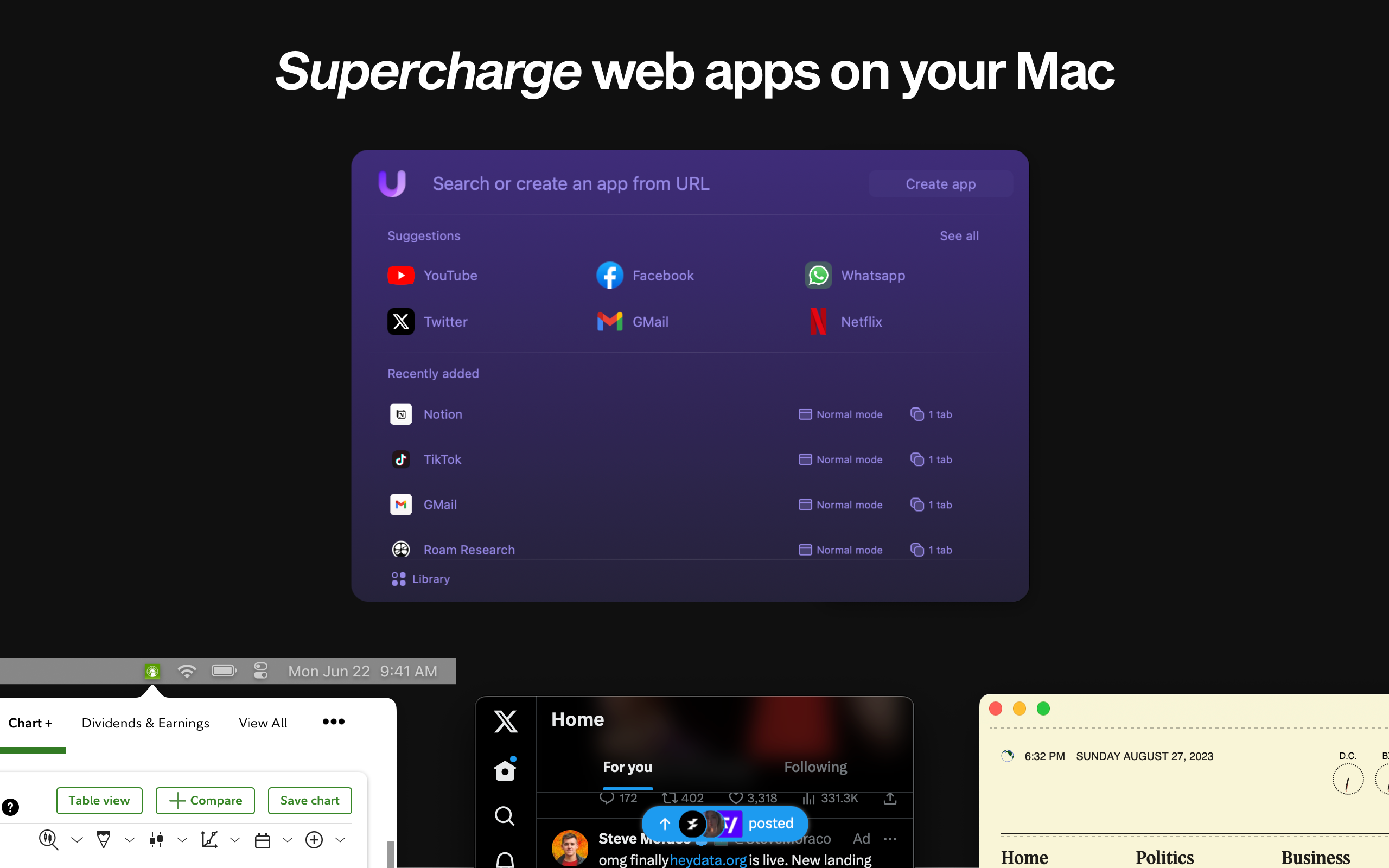
Unite 5 for macOS takes your web experience to the next level, transforming websites into feature-rich Mac apps. Powered by a completely redesigned WebKit browser, Unite 5 offers a more immersive and customizable browsing experience.

Unite 5

What sets Unite 5 apart? We’ve gone beyond just app conversion. Our new intricate link-forwarding rules give you unparalleled control over web interactions, making your web apps smarter and more integrated than ever before.

Continue reading ⇢

Goodbye, Surface Studio⇢

For years, Apple fans have looked at the Surface Studio longingly, wondering what a version of a tilting Mac desktop could look like. Many wondered if Apple would ever do anything like this machine, adding Apple Pencil and touch support to macOS, or doing some wild Mac/iPad hybrid.

I fear Apple won’t ever get that weird with its products, and it seems like Microsoft is backing out as well, according to Zac Bowden:

Continue reading ⇢

Strategic Linear Contextual Bandits⇢

Thomas Kleine Buening, Aadirupa Saha, Christos Dimitrakakis, Haifeng Xu, on Apple’s “Machine Learning Research” blog:

Motivated by the phenomenon of strategic agents gaming a recommendation system to maximize the number of times they are recommended to users, we study a strategic variant of the linear contextual bandit problem, where the arms strategically misreport privately observed contexts to the learner. % under strategic context manipulation. We treat the algorithm design problem as one of \emph{mechanism design} under uncertainty and propose the Optimistic Grim Trigger Mechanism (OptGTM) that minimizes regret while simultaneously incentivizing the agents to be approximately truthful. We show that OptGTM achieves sublinear regret despite the agents being unrestricted in their ability to game the learning algorithm by misreporting contexts. We then also show that failing to account for the strategic nature of the agents results in linear regret. However, a trade-off between incentive-compatibility and regret minimization is shown to be unavoidable. More broadly, this work provides insight into the intersection of online learning and mechanism design.

Continue reading ⇢

The Verge Launches Its Subscription⇢

Nilay Patel:

Today we’re launching a Verge subscription that lets you get rid of a bunch of ads, gets you unlimited access to our top-notch reporting and analysis across the site and our killer premium newsletters, and generally lets you support independent tech journalism in a world of sponsored influencer content. It’ll cost $7 / month or $50 / year — and for a limited time, if you sign up for the annual plan, we’ll send you an absolutely stunning print edition of our CONTENT GOBLINS series, with very fun new photography and design. (Our art team is delightfully good at print; we’ve even won a major magazine award for it.)

A surprising number of you have asked us to launch something like this, and we’re happy to deliver. If you don’t want to pay, rest assured that big chunks of The Verge will remain free — we’re thinking about subscriptions a lot differently than everyone else.

Let me explain.

Continue reading ⇢

The Flexbar⇢

Andrew Liszewski, writing at The Verge, about a thing that should probably not be made:

Apple may have said goodbye to the MacBook Pro’s Touch Bar last year, but a team of four engineers believes the concept deserves a second chance. They’ve created the Flexbar, which is essentially a standalone version of the MBP’s thin touchscreen display that can be used with multiple devices and platforms through a USB connection.

The Flexbar’s creators have started a new company, Eniac, which is attempting to bring the accessory to consumers through a Kickstarter crowdfunding campaign. The earliest backers can preorder one discounted to $119 from the full MSRP of $179, with delivery expected as early as February 2025.

Continue reading ⇢

Upgrade 540: Validation for Shower Jason⇢

Myke Hurley was out this week, so I joined Jason Snell for today’s episode of Upgrade:

Stephen Hackett joins Jason to discuss emergency calls, reaction to Jason’s “The Mac is the Model” piece, iPhone metals, our innate troubleshooting powers, Jason’s laptop dilemma, the ChatGPT Mac app, and some very old Vision Pro news.

On Upgrade+, I had Jason price out a MacBook Pro, then we talked about our Thanksgiving breaks.

Continue reading ⇢

Sponsor: Rogue Amoeba’s SoundSource⇢

Do you use audio on your Mac, in any way at all? Then SoundSource is for you. SoundSource provides superior control over all audio, right from your menu bar.

With SoundSource, you get:

Per-application control: Change the volume of any app relative to others, and play individual apps to different audio devices.

Audio effects, anywhere: SoundSource has great built-in effects, like Magic Boost and Volume Overdrive, as well as a built-in 10-band equalizer to sweeten sound. Advanced users will love the ability to apply Audio Units like “Sound Isolation” to any audio.

Continue reading ⇢