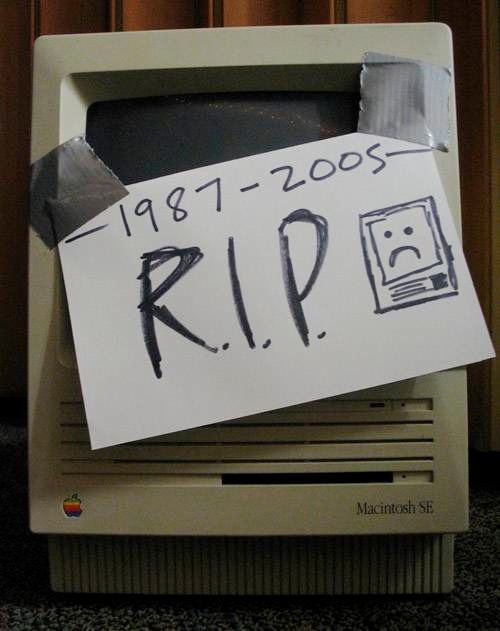
Inside the Macintosh SE⇢

The Macintosh SE was perhaps the most successful compact Mac. It was the first to support ADB, come with an internal hard drive an an external SCSI port.

I own two of them. One still works, but the other (which is in far better physical shape) died back in 2005.

Continue reading ⇢

On The Lisa’s Place in History⇢

Benj Edwards, in another great Apple history piece at Macworld:

The Mac borrowed heavily from the Lisa, and the Mac went on to great things while the Lisa floundered. As a result, it’s tempting to treat the Lisa as merely a footnote in the history of Apple. But as anyone who has used a real Lisa knows, Apple’s first GUI-based computer played host to many distinctive quirks and traits that tend to get overlooked in the history books.

Continue reading ⇢

The Macintosh Papers⇢

Jef Raskin, the 31st employee at Apple, was tasked with starting the publications department. After getting user manuals for the Apple II out the door, he created the original vision of the Macintosh — an appliance-like computer with a GUI and simple design.

After Steve Jobs was sidelined from the Lisa and Apple II groups, and took over the Mac team, Raskin left.

These papers are the birthplace of the Macintosh, and are well worth the read. I saved a PDF of the papers, and sent the text to my Kindle as well.

Continue reading ⇢

A Look Back at Safari’s Decade of Browsing

Don Melton has published a little piece on how Apple’s web browser is now a decade old:

Ten years ago today, which was actually a Tuesday, Steve Jobs introduced Safari to the public at MacWorld in San Francisco.

He links to Macworld 2003 keynote address, in which Steve Jobs demos the browser for the first time.

I remember the announcement — and being stoked about it. Remember, January 2003 is years before Google Chrome, and almost two years before Firefox shipped.

Continue reading ⇢

The Sad Tale of Two Apple Audio Players

While Apple’s iPod line is world-famous, the company has had a couple of audio products that weren’t such stars. One is much more recent than the other, but both hold a unique place in Apple history.

Apple PowerCD

image via Wikipedia

In mid–1992, riding a high from the Newton, Apple’s Industrial Design Group started a sub-group named “Mac Like Things.” The only project to ever come out of the group was the PowerCD, which Apple released in 1993.

Continue reading ⇢

On The PowerBook G3

Like the iMac G3, the PowerBook G3 line of notebooks helped revive Apple in the late 90s and the first year of the 21st century. Apple took the power of the G3 processor and put it in a mobile workhorse. Let’s look at exactly what the company did with these machines:

The Kanga

PowerBook G3 ‘Kanga’ image via retromaccast on Flickr

In many ways, the original PowerBook G3 was a stopgap machine. Only available from November 1997 to May 1998, the machine was basically a PowerBook 3400c with a 250 MHz G3 processor, faster motherboard and quicker RAM. (In fact, this machine is sometimes nicknamed the 3500.) These upgrades made the Kanga twice as fast as the the 240 MHz PPC 603ev-based 3400c.

Continue reading ⇢

iMac G3: The Macintosh That Saved Apple

On May 6, 1998, Steve Jobs took the stage and announced the iMac G3, a consumer counterpart to the G3-powered PowerMac and PowerBook, the only remaining computers in Apple’s lineup after he had slashed all other machines, including the popular Performa line.

“The back of our computer,” he said, “looks better than the front of the other guys’. It looks like it’s from another planet. A good planet. A planet with better designers.”

Continue reading ⇢

On the 20th Anniversary Mac

At Macworld San Francisco in January of 1997, Apple announced the 20th Anniversary Macintosh. Built to celebrate the company’s birthday which had occurred the previous year, the machine was constructed with gold-colored plastics, fabric and leather. It shipped on March 20, 1997 and a retail price of US$7,499.

(Don’t miss the company’s product video for the machine.)

Apple manufactured only 12,000 TAMs, with a release run of 11,601. The remaining 399 were kept by Apple for use as spare parts. The machine was only for sale in the US and UK, as well as Japan, France, Germany.

Continue reading ⇢

Apple’s Mouse: A History

1983: The Lisa Mouse (Model A9M0050)

A year before the Macintosh was released, Apple’s Lisa introduced the concept of a GUI and mouse to Apple’s customers. Often considered to be ahead of its time, the Lisa also offered protected memory, limited multitasking, hard disk support and more. Ultimately a failure, the Lisa was priced at $9,995.

1984: The Macintosh Mouse (Model M0100)

This is the mouse that put mice on the map.

Continue reading ⇢