
On Wednesday night, NASA Administrator Jared Isaacman revealed that the Crew-12 and Artemis II astronauts will be allowed to bring iPhones and other modern smartphones into orbit and beyond.
“NASA astronauts will soon fly with the latest smartphones, beginning with Crew-12 and Artemis II,” Isaacman wrote on X. “We are giving our crews the tools to capture special moments for their families and share inspiring images and video with the world.”
NASA astronauts have long captured amazing photos from the space station, but having a smartphone on hand will open up a world of video possibilities. This will likely be especially useful when astronauts are conducting an experiment or looking outside a window and see an interesting, transient phenomenon.
Category: Apple
Resizing Columns to Automatically Fit Filenames Could Be the Greatest Addition to Finder in Years⇢
John Gruber is still using macOS Sequoia, but he recently came across one feature of Tahoe worth upgrading for:
But now that we’ve been poking around at column view in the Tahoe Finder, Jeff Johnson has discovered another enticing new feature. On Mac OS 26, the Finder has a new view option (accessed via View → Show View Options) to automatically resize columns to fit the longest visible filename. See Johnson’s post for screenshots of the new option in practice.
Apple Creator Studio Announced⇢
Back in the day, Apple had three suites of applications:
- iWork, which started with Keynote and Pages, then Numbers
- iLife, which included iTunes, iPhoto, iMovie, iDVD, GarageBand, and for a short time, iWeb.
- Final Cut Studio, which was home to Final Cut Pro, Motion, Soundtrack Pro, DVD Studio Pro, Color, Compressor, Cinema Tools, and Qmaster.
Apps like Aperture and Final Cut Express were also around for a while. Meanwhile, Logic and MainStage are just out there doing their own things. I don’t even know what’s going on with Freeform, as it’s updated with OS releases, not as a standalone app like the others.
Review: The MacBook Pro
This week marks the 20th anniversary of the original MacBook Pro. In the spirit of this article, I’m going to review it as if I were blogging about Macs back in 2006. Just go with me here.
My Laptop History
I have been a PowerBook G4 user since 2002, when my boss handed me a 1 GHz Titanium PowerBook to use for page layout, audio editing, and other media tasks at the non-profit where I spent time after school and on weekends.
Apple’s Rumored Foldable May Be Smaller Than We Think⇢
If many years-long rumors are true, 2026 will be the year when Apple’s long-gestating folding iPhone becomes a reality. But there are a lot of different approaches to folding phones out there, and there’s no guarantee that the folding iPhone you imagine is the one that Apple is imagining.
Leaks from Apple’s supply chain have begun to strongly suggest the shape and size of the product we’ll call, for lack of a better name, the iPhone Fold. And since it’s likely going to be nine months before anyone holds one of these things in their hands, this seems like as good a time as any to consider the story Apple is likely to tell when it’s selling this device.
Four Winners and Losers of Apple’s 2025
Apple’s year is just about done, so it’s time to pick some high and low points.
Winners: UI Experts on Social Media
macOS Tahoe, iOS 26, and their cousins will go down in history for being the releases that introduced Liquid Glass.
One of Apple’s stated desires with this design language was to unify its platforms with one universal look and feel, as shown off in the image at the top of the company’s press release about Liquid Glass:
So, Three Things
When Steve Jobs unveiled the iPhone in January 2007, his words made their way into history:
Today, we’re introducing three revolutionary products of this class. The first one is a widescreen iPod with touch controls. The second is a revolutionary mobile phone. And the third is a breakthrough Internet communications device.
So, three things; a widescreen iPod with touch controls, a revolutionary mobile phone and a breakthrough Internet communications device. An iPod, a phone and an Internet communicator… an iPod, a phone and an Internet communicator… are you getting it? These are not three separate devices. This is one device, and we are calling it iPhone.
Today, Apple is going to reinvent the phone.
Gonennandrea
Apple today announced John Giannandrea,1 Apple’s senior vice president for Machine Learning and AI Strategy, is stepping down from his position and will serve as an advisor to the company before retiring in the spring of 2026. Apple also announced that renowned AI researcher Amar Subramanya has joined Apple as vice president of AI, reporting to Craig Federighi. Subramanya will be leading critical areas, including Apple Foundation Models, ML research, and AI Safety and Evaluation. The balance of Giannandrea’s organization will shift to Sabih Khan and Eddy Cue to align closer with similar organizations.
Since joining Apple in 2018, Giannandrea has played a key role in the company’s AI and machine learning strategy, building a world-class team and leading them to develop and deploy critical AI technologies. This team is currently responsible for Apple Foundation Models, Search and Knowledge, Machine Learning Research, and AI Infrastructure.
Subramanya brings a wealth of experience to Apple, having most recently served as corporate vice president of AI at Microsoft, and previously spent 16 years at Google, where he was head of engineering for Google’s Gemini Assistant prior to his departure. His deep expertise in both AI and ML research and in integrating that research into products and features will be important to Apple’s ongoing innovation and future Apple Intelligence features.
iPhone Pocket⇢
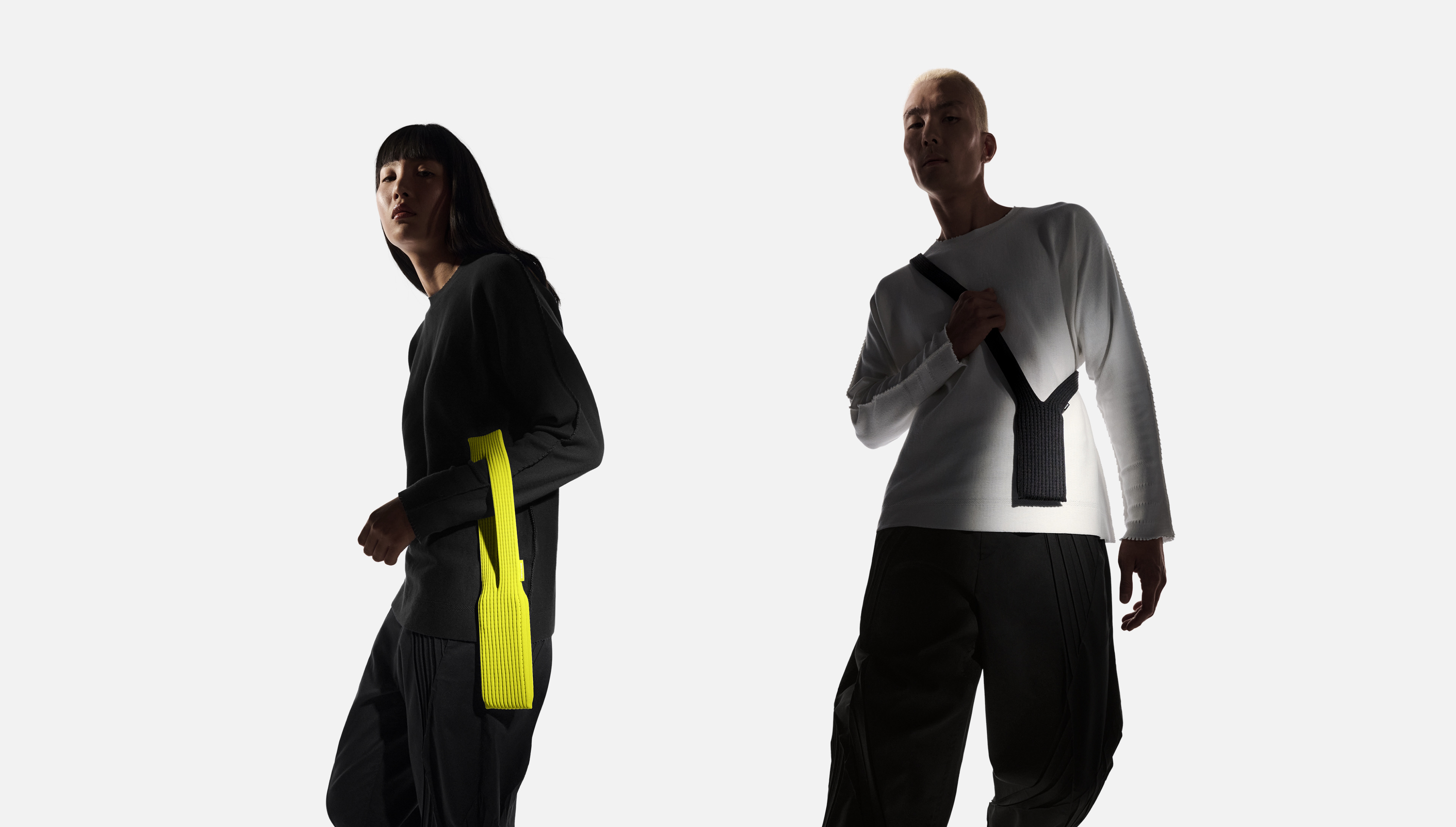
ISSEY MIYAKE and Apple today unveiled iPhone Pocket. Inspired by the concept of “a piece of cloth,” its singular 3D-knitted construction is designed to fit any iPhone as well as all pocketable items. Beginning Friday, November 14, it will be available at select Apple Store locations and on apple.com in France, Greater China, Italy, Japan, Singapore, South Korea, the UK, and the U.S.
iPhone Pocket features a ribbed open structure with the qualities of the original pleats by ISSEY MIYAKE. Born from the idea of creating an additional pocket, its understated design fully encloses iPhone, expanding to fit more of a user’s everyday items. When stretched, the open textile subtly reveals its contents and allows users to peek at their iPhone display. iPhone Pocket can be worn in a variety of ways — handheld, tied onto bags, or worn directly on the body. Featuring a playful color palette, the short strap design is available in eight colors, and the long strap design in three colors.
‘If You Can Beat Them Handily, Do It’⇢
John Gruber, in his M1 Mac review back in November 2020:
The logic behind Apple’s transition then to Intel boiled down to another old axiom: If you can’t beat them, join them.
The logic behind Apple’s transition now to Apple Silicon is this: If you can beat them handily, do it.
The M1 Macs are such better machines than their Intel-based predecessors it’s hard to believe. Apple’s battery life braggadocio is warranted. The battery just lasts and lasts and lasts. I’ve been using this MacBook Pro almost exclusively on battery power all week, doing both all my normal work and running benchmarks and performance-stressing tasks, and I can’t come close to depleting it in a full day of work.
It never gets hot. In normal use, it doesn’t even get warm. Maybe, sort of, when running a fully-taxing test like the Cinebench multi-core CPU benchmark, it heats up to just past room temperature above the Touch Bar, but it bears no resemblance thermally to a taxed Intel-based MacBook Pro.
Five Years of Apple silicon Macs
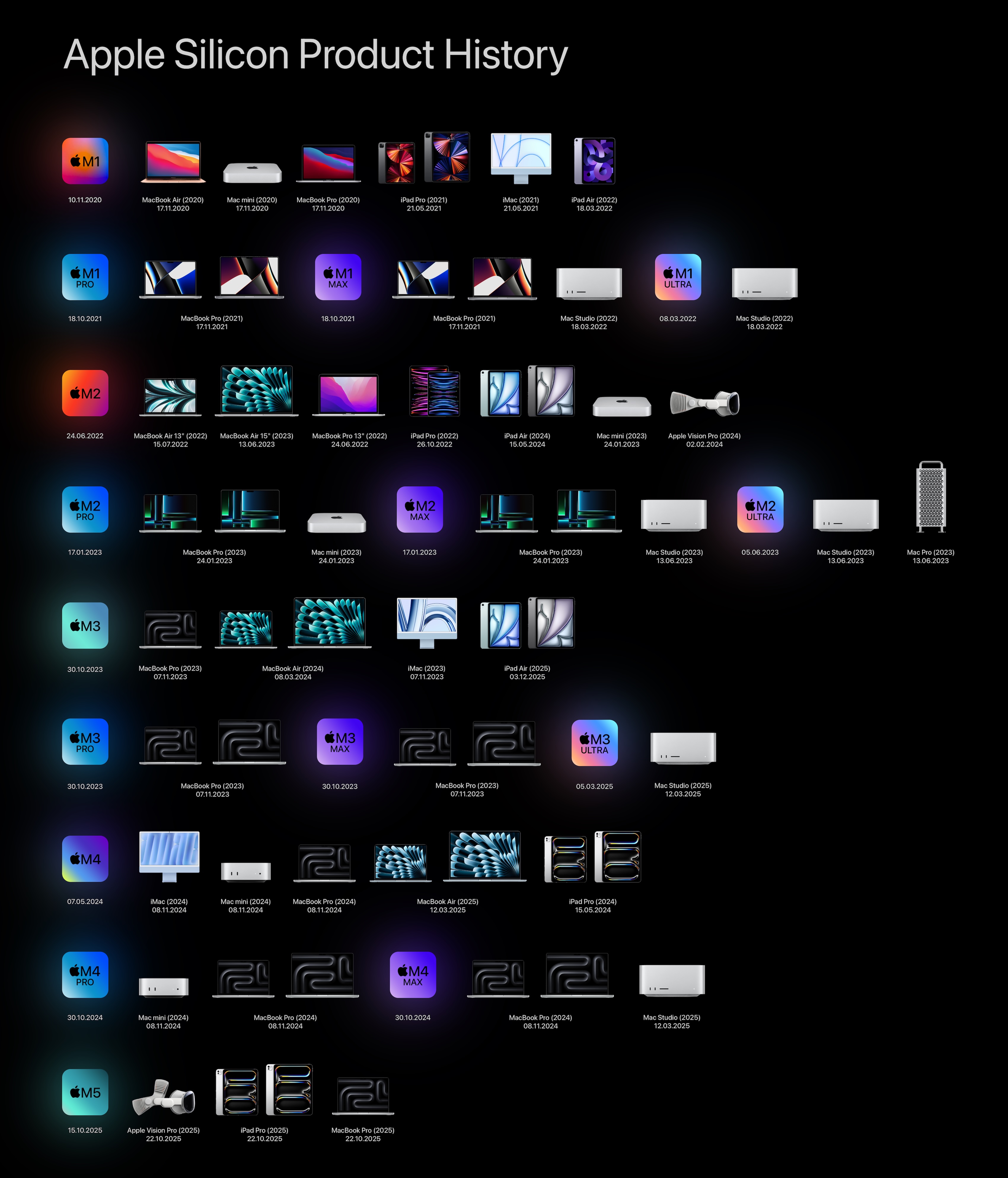
Five years ago, the first Apple silicon Macs shipped. While the MacBook Air, 13-inch MacBook Pro, and Mac mini looked like their Intel predecessors, they were vastly better machines.
To celebrate the anniversary, Basic Apple Guy created an impressive graphic outlining the releases we’ve seen since 2020:
Over on Macworld, Jason Snell wrote about what this change has meant for the Mac:
Then the results of the first M1 speed tests arrived, and nothing felt scary anymore. Everything was fast, much faster than Intel, so much faster that even software compiled for Intel running in a code-translation layer via Rosetta ran just fine. In fact, the M1 was such a fast chip that, five years later, Apple’s still selling the M1 MacBook Air. (For $599, at Walmart.) And it’s still a pretty nice computer!
Apple’s next trick was rolling out new versions of (almost) every Mac model, redesigned for Apple silicon, as well as an entirely new model, the Mac Studio. The new chips, new designs, and a pandemic-fueled increase in people working from home all sent Mac sales soaring.
The five years before the arrival of Apple silicon were the five best years in the history of Mac sales to that point, averaging $25.5 billion a year. It was a pretty scary move to pull the rug out from under the Intel Mac era, but Apple’s move was vindicated: The first five years of Apple silicon are now the five best years in the Mac’s history. Mac sales were up nearly one-third compared to the previous five-year period, to $33.7 billion a year on average.
On Tahoe’s Terrible Icons⇢
Paul Kafasis has looked into the abyss of Tahoe icons:
On the new MacOS 26 (Tahoe), Apple has mandated that all application icons fit into their prescribed squircle. No longer can icons have distinct shapes, nor even any fun frame-breaking accessories. Should an icon be so foolish as to try to have a bit of personality, it will find itself stuffed into a dingy gray icon jail.
While Apple had previously urged developers to use squircle icons on our apps, they’ve now taken things much further to ensure compliance. It’s a shame.
Apple updated their own app icons on Tahoe, for both the squircle shape as well as the new “ Liquid Glass” interface. Mostly, these icons seem dumbed-down, with a loss of detail.