512 Pixels

Why Vaccine Cards Can’t Fit in a Wallet ⇢

Amanda Mull at The Atlantic:

When you hold one of the vax cards, you can see how people would immediately misunderstand it as something that’s meant to be kept on your person. Although too big for a wallet, they’re also too small to easily keep track of outside a wallet. “It’s absolutely the wrong size,” Alison Buttenheim, a professor at the University of Pennsylvania School of Nursing who has studied vaccine documentation, told me. She noted that the cards don’t match the dimensions of any other common vaccine documentation she knows of, including the yellow booklet that the WHO uses for international travelers, which is bigger. As we were talking, Buttenheim briefly misplaced her own folded-over vaccination card; it slid a little too far into one of her wallet’s compartments. (At this point, I should admit that I again lost mine in my apartment for most of a day after getting it out to examine for this article.)

I not only have mine scanned as a PDF in Craft, but I also have a picture of it in Photos, saved as a favorite for quick access.1


  1. Not that it matters in my state at all. ↩︎
Kbase Article of the Week: iMac G5 (iSight): iChat or Photo Booth Doesn‘t Show Video ⇢

Apple Support:

If you may see a ‘green screen’ when you launch Photo Booth or iChat (or any application that uses the built-in iSight camera) on your iMac G5 (iSight), be sure to update to Mac OS X 10.4.3. You can use Software Update to download and install the update, or download it from Apple Downloads. Be sure that you shut your computer down completely (not just restart) after installing the update. iChat and Photo Booth should behave as expected after this.

If you can’t update right away, try quitting and starting the application again. If the issue continues after updating, disconnect any external video cameras (including webcams, TV tuners, DV cameras, or DV converters) that may be connected via FireWire or USB and try again.

Mac Power Users #600: Mac Migration & Settings ⇢

This week on episode 600(!) of Mac Power Users:

The Apple silicon transition continues to march on, so David and Stephen sit down to talk about how to migrate to a new Mac, and what settings and preferences they recommend changing from the defaults.

We’ve seen a lot of questions about the best way to move to a new machine, so hopefully this episode clears things up for everyone. It’s an exciting time to be in the market for a new Mac!

My thanks to our sponsors:

  • Memberful: Best-in-class membership software for independent creators, publishers, educators, podcasters, and more. Get started now, no credit card required.
  • 1Password: Have you ever forgotten a password? You don’t have to worry about that anymore.
  • Electric: Stop stressing over scattered devices. Get a free pair of Beats Solo3 Wireless Headphones when you schedule a meeting.

Sponsor: Loopback from Rogue Amoeba ⇢

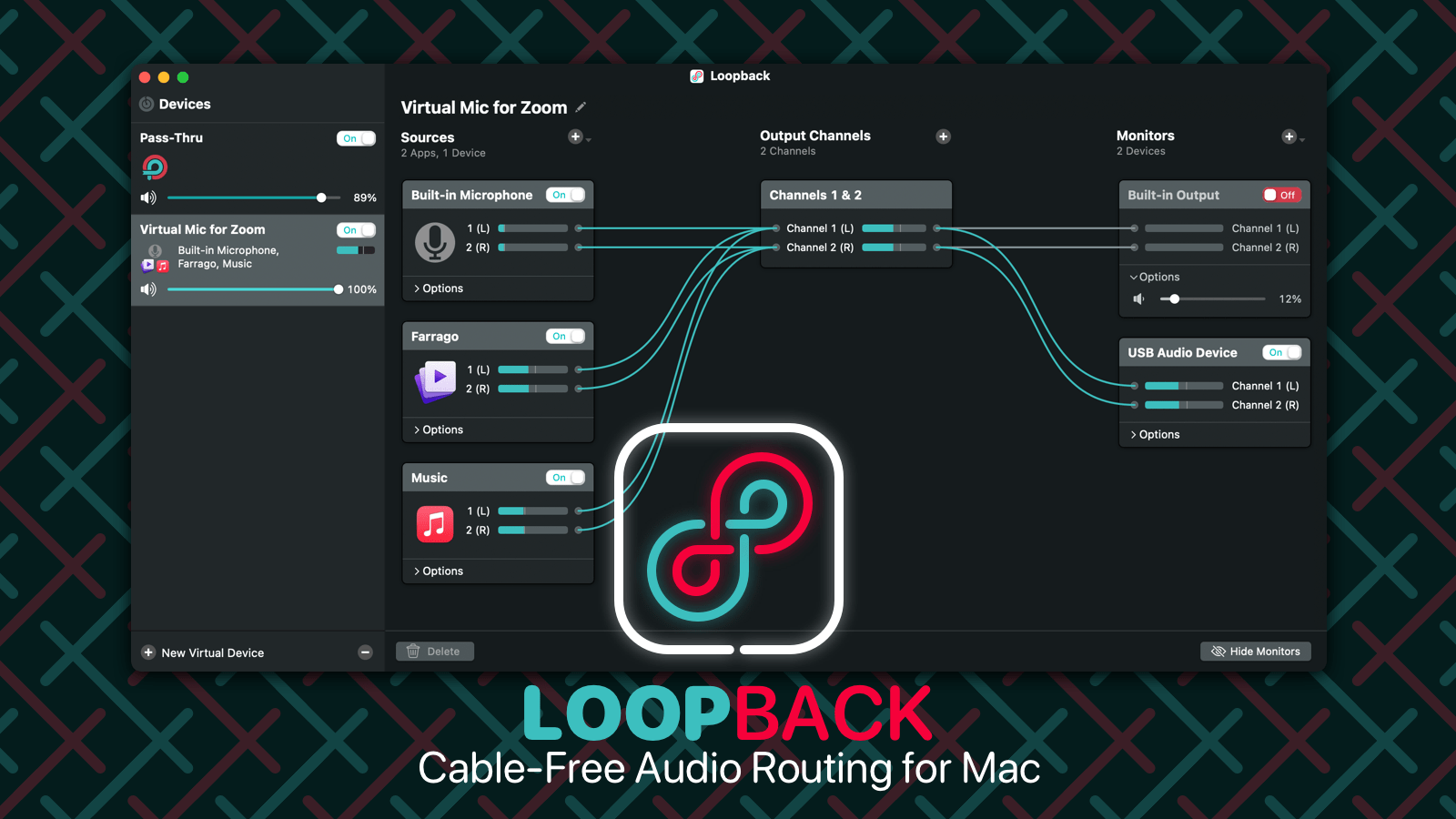
With Loopback, it’s trivial to pass audio from one application to another on your Mac. Need to play a recording into Zoom? Add sound effects into a podcast? Include music in a streamed event? Loopback gives you the power to do just that with just a few clicks. It’s like a high-end mixing board, right inside your Mac.

Loopback creates virtual audio devices, which merge audio from multiple applications and input devices into a single source. These virtual devices appear on your Mac just like a real, physical device, and can be selected for use in any audio app on your Mac. It’s incredibly powerful.

Loopback

Fortunately, it’s also incredibly easy to use. Loopback’s intuitive wire-based setup makes it easy and obvious to understand exactly how your virtual devices work. Configure, adjust, and experiment, just by clicking and dragging.

Whether you’re a podcaster, a live performer, a tabletop gamer, or even just someone stuck on too many Zoom calls, Loopback can help you.

Check out Loopback today, with a free trial. Through August 31, 512 Pixels readers can save 21% with coupon code HACK21.

Drang’s Homemade Wiki ⇢

Last week, Dr. Drang was on MPU, and among other things, we spoke about this homemade wiki for dealing with information he needs handy. He’s followed up on that episode with a pair of blog posts:

David and Stephen recently had me on the Mac Power Users podcast and teased me (gently) about rolling my own wiki instead of using one of the many off-the-shelf systems. I explained on the show the various trials I went through before landing on my current system and—to some extent, at least—the reason I prefer what I’m doing to Obsidian/Craft/Roam Research/Notion/Whatever. In this post I’ll give some details on how my system works.

The Operating Systems Family Tree ⇢

Alphonse Eylenburg has created something wonderful:

In this post you’ll find a family tree and timeline of operating systems. I have tried to include all operating systems, no matter how old or obscure. Of course, a complete list is virtually impossible, as there is no way to catalogue all the tiny hobby and embedded systems that may exist somewhere.

Please also note that I only included a few selected Linux/BSD/Solaris distributions (it is arguable whether these should count as an OS on their own or not).

Currently, the family tree includes between 800 and 900 different operating systems.

Connected #357: I Need my Hands, Especially in the Summer ⇢

This week on Connected,

Myke is away, so Stephen talks about the Mac Pro and Federico talks about emulating old video games. Also: MagSafe PopSockets, shipping challenges and the future of the Jeremies.

On Connected Pro, I share my thoughts on my first new TV in a decade and Federico makes a decision about spatial audio.

My thanks to our sponsors:

  • Instabug: Ship Quality Apps with Real-Time Contextual Insights
  • Squarespace: Make your next move. Enter offer code CONNECTED at checkout to get 10% off your first purchase.
  • TextExpander, from Smile: Communicate Smarter. Get 20% off.

Mac Pro Gets GPU Upgrades ⇢

Jason Snell, known mocker of my Mac Pro:

It’s not dead yet! On Tuesday, Apple rolled out three new graphics card modules for the Intel-based Mac Pro, all based on AMD’s Radeon Pro W6000 series GPU. (Apple posted a Mac Pro performance white paper to celebrate.) The new modules (in Apple’s MPX format) come in three variants, with a Radeon Pro W6800X, two W6800X GPUs, and the W6900X. Each module also adds four Thunderbolt 3 ports and an HDMI 2 port to the Mac Pro.

If you have a Mac Pro you want to update, the cards are on sale as stand-alone components as well.

Sponsor: TextSniper - OCR Simplified ⇢

TextSniper is a Mac OCR app that can extract text anywhere on your Mac’s screen and automatically save it to your clipboard so that you can paste it into a live document or anywhere you need it.

TextSniper is a bit like Live Text, but with fewer limitations. You can run it on any Mac starting from macOS Catalina today. It is application and file format agnostic; whatever you see on your screen in no time can be turned into editable text.

TextSniper can even read the text to you. The whole thing works a lot like the built-in snipping tool on Mac, just way more powerful.

TextSniper doesn’t collect your data. The text recognition is processed on your Mac and does not require an internet connection. With TextSniper, you can:

  • Quickly get an editable text from PDFs, Zoom calls, presentations, and videos.
  • Copy text from anywhere, even images and websites that don’t let you select text.
  • Quickly grab data like email addresses, phone numbers, links, etc.
  • Read QR codes and barcodes.
  • Get text out of just about any image format, including JPG, PNG, GIF, TIFF, and BMP.

Tired of re-typing text from images? Get TextSniper now and speed up your screenshot to text workflow! Use the promo code 512pixels to get 20% off this week.