I’m getting a lot of tweets and emails saying the same thing: the latest episode of (some podcast I’m involved with) hasn’t shown up in Apple Podcasts.
Unfortunately, right now my only answer is to say, “It’s displaying properly in every other podcast app around, so if you’ve ever thought of using Overcast or Castro or Pocket Casts or any other alternative podcast app, now might be a good time to try.”
This is an issue on Apple’s side. Apple is aware of it and presumably is working on a fix.
I do have a theory about what’s happening, though.
We’re seeing this with Relay FM shows, and it’s really frustrating for us and listeners both. I sure hope this will be resolved sooner rather than later.
Twitter announced today that they will be acquiring Scroll and this version of Nuzzel will be shutting down on May 6, 2021. However, Twitter has spun up an internal team of Nuzzel acolytes whose goal is to take the best of the Nuzzel experience and build it directly into Twitter. Nuzzel users who are interested in helping us define what that should look like or get early access to what we build should sign up here.
I really hope these plans pan out; Nuzzel was great.
There are some amazing websites on the Internet, but nothing can ease the pain brought by iPad mini rumors. Stephen knows about sound, Myke has a new keychain and Federico has a story to tell about Obsidian.
My thanks to our sponsors:
Pingdom: Start monitoring your website performance and availability today, and get instant alerts when an outage occurs or a site transaction fails. Use offer code CONNECTED to get 30% off. Offer expires on January 31, 2022, and can be used only once.
Scorecard is a new $5 app from the fine folks over at Lickability that makes it easy to track scores without the need of notebooks, pencils and arguments. It all syncs with iCloud and can track multiple different games over time. As you’d expect from Lickability, the polish on this app is outstanding.
Apple supplier TSMT, a key vendor involved in the production of mini-LED displays in the newly announced 12.9-inch iPad Pro, has been able to address technical challenges for the production of mini-LED displays to be used in the upcoming 14 and 16-inch redesigned MacBook Pros.
[…]
The redesigned 14 and 16-inch MacBook Pros are expected to feature next-generation Apple silicon chips, the removal of the Touch Bar, the return of the MagSafe magnetic power cable, and an overall new design with an HDMI port and SD card slot.
The iPad is a truly magical piece of glass. It’s the primary computer for many. That’s why Thord D. Hedengren started Switch to iPad, a weekly newsletter about making the switch to a better computing life.
Switch to iPad isn’t just for those who have made the switch from a traditional computer to a more versatile one. It’s a newsletter about getting the most out of your iPad.
So far, Thord has discussed things like note-taking, developing and designing on an iPad, email apps, games, and a lot more. At the time of writing, there are 44 issues of Switch to iPad sitting in the archive. That’s more than 60,000 words about the iPad, right there.
Many of those words are free to read, but the majority requires a paid subscription. Supporting Switch to iPad costs $5/month or $50/year, but 512 Pixels readers can try it free for 14 days, no strings attached, using this link.
Take a look at Switch to iPad, read a couple of issues and if it’s your cup of tea, consider a subscription.
The Intrazone, by Microsoft SharePoint: Your bi-weekly conversation and interview podcast about SharePoint, OneDrive and related tech within Microsoft 365.
DEVONthink: Get Organized — Unleash Your Creativity. Use this link for 10% off.
This event came just a few months after the launch of the Titanium PowerBook G4, and Apple’s notebook game had never been stronger. In fact, Jobs announced that notebooks accounted for nearly 30% of the company’s Mac sales, up from less than 20% just a year before.
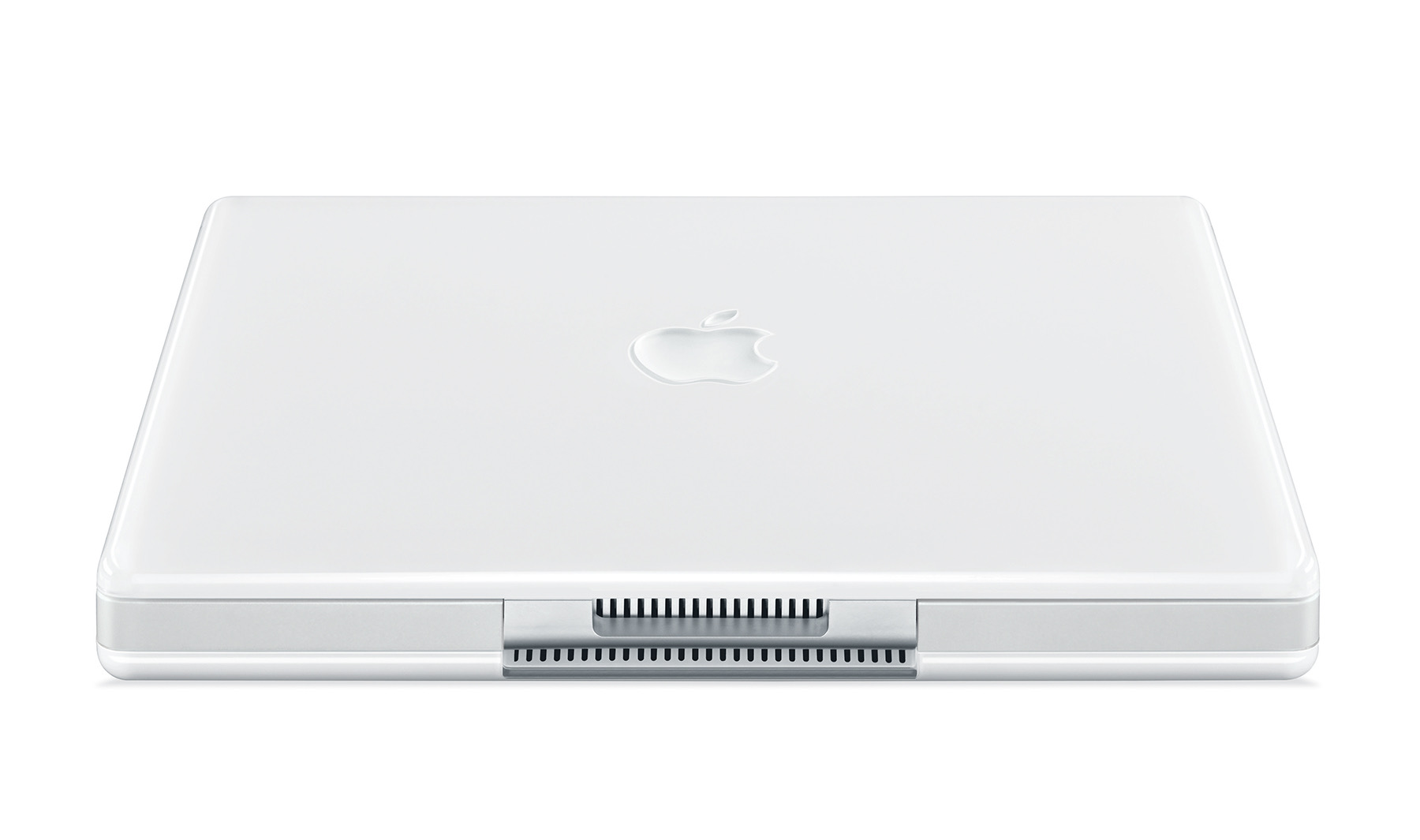
Gone were the swooping edges and vibrant colors of the original iBook; this new iBook G3 was far more conservative in design, being dressed in all white.
The top and bottom parts of this enclosure were actually made of clear plastic that had white paint applied to the inside, giving it a slightly frosted look, earning it the nickname “IceBook.” This design lent itself to some … interesting modifications made by some users.
The new iBook was 4.9 pounds, a huge reduction from the 6.7 pound Clamshell. It was also some 35% thinner. As Jobs was quick to point out, this made the iBook the thinnest and lightest notebook in its class.
This was made possible by Apple ditching the large rubber-injected molding that gave the original iBook its rugged nature.
That said, Jobs insisted that the new machine would still hold up to the demands of being used in the home and in schools, saying it proved to be “twice as durable” in Apple’s internal testing. The hard drive was rubber-mounted to absorb shocks and the magnesium frame was meant to be strong and light, but as many Apple techs from back in the day will tell you, it wasn’t uncommon to see iBooks with broken frames come in for repair.
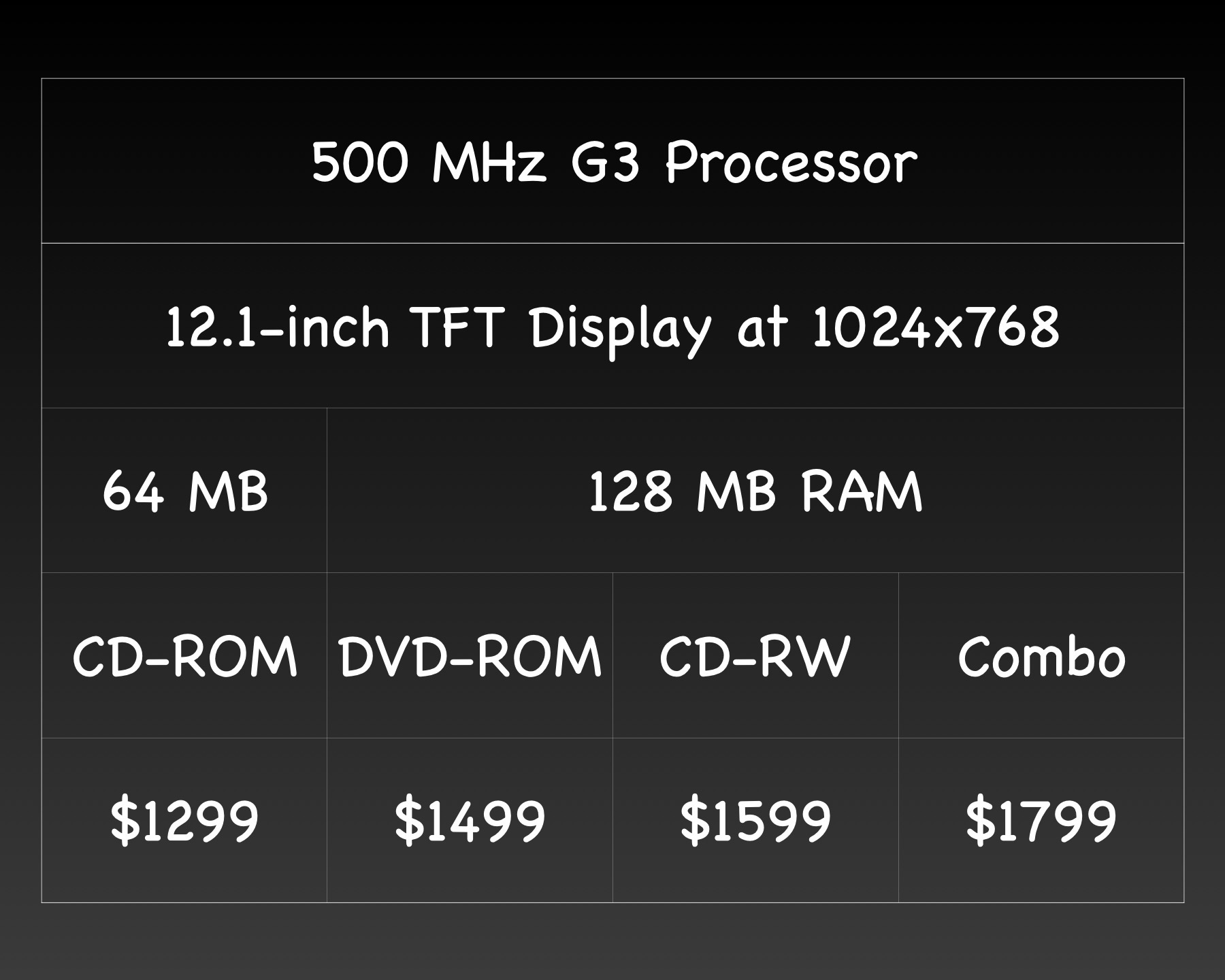
The display was still a 12-inch LCD, but now running at 1024x768, an upgrade from the old 800x600 panel. The additional space made running Mac OS X much more comfortable, and matched the number of pixels on the iMac G3.
The screen rotated down and away from the keyboard on a new hinge that was markedly better than anything Apple had shipped on a notebook before. I honestly think the hinge feel holds up today, two decades later.
The I/O on the new machine was also an upgrade from before, with an additional USB port joining the single port on the Clamshell. It joined the power, FireWire, Ethernet, modem, mini-VGA and the combo audio/composite video ports, all along the left side of the machine.
Inside, the iBook had been improved as well. The Clamshell topped out 466 MHz, but the new iBook was clocked at 500 MHz and could be equipped with up to 640 MB of RAM. The display was powered by the ATI Rage Mobility 128 GPU 8 MB of video memory, which was the same as the FireWire-equipped Clamshell models.
The laptop could be outfitted with one of four optical drives:
CD-ROM player
DVD-ROM player
CD-RW burner
Combo (DVD-ROM + CD-RW burner)
Prices ranged from $1,299 to $1,799 — $200 less than the Clamshell:
Regardless of price, the iBook came with a 10 GB hard drive, something Apple would improve drastically later in 2001 when it revised the machine for the first time.
“The new iBook is wonderfully small and light, and packs in all the amazing features you’d expect from Apple,” said Steve Jobs, Apple’s CEO. “With iMovie, iTunes and iTools, the new iBook builds on the incredible success of the original iBook and is designed to fit today’s digital lifestyle.”
Every iBook is powered by 500 MHz PowerPC G3 processors, and offer up to twice the onboard memory, twice the memory expansion, and twice the storage than previous models. iBook’s new stunning design is almost two pounds lighter and twice as durable than previous models, and small enough to easily fit into any backpack or computer bag. Made for students and consumers alike, iBook’s streamlined impact resistant polycarbonate enclosure has no doors protruding, latches or levers to break or accidentally catch.
I encourage you to watch the video, but I love how the whole thing is announced. Jobs talked about the specs for over ten minutes, before ever showing off the iBook’s new design. He holds it up compared to a Dell, making fun of the PC’s design and features before Apple employees passed iBooks down the rows of journalists in the audience. As they looked at the machines, Jobs answered a couple of questions about the notebook, and he shared that the notebook did have a fan, and that the only color it came in was white.
Schools
After announcing and showing off the new iBook, Jobs demoed it for the audience, showing iTunes, iMovie, and the DVD Player all running on the 12-inch machine. Despite its size, Apple wanted people to see the iBook as worth of being part of the company’s Digital Hub strategy.
After that, Jobs spoke about the importance of education to Apple, leaning on its history with schools going back to the Apple II. However, he then spoke about dedicated computer labs and how the idea of moving student into a room full of computers was an outdated idea. With wireless notebooks, computers could come to the students, he said, showing off a cart full of iBooks on the screen behind him. Apple was the number one computer company in education, he said, and Apple planned on keeping that title. In fact, the iBook could be bought starting at $1,199.
Jobs then announced a huge deal with Henrico County Public Schools in Richmond Virginia, with 23,000 notebooks making it the largest portable computer order in education to that point. Every middle school student, high schooler and teacher in the district would have their own iBook G3.
“This is the mammoth–the single largest sale of portable computers in education ever,” said Steve Jobs, Apple’s CEO. “Apple is thrilled to partner with Henrico County Public Schools in their revolutionary initiative because when every student and teacher has access to wirelessly-networked mobile computing, learning reaches far beyond the classroom.”
“Students, teachers, parents and the community will now have the best technology tools in the world at their fingertips every day,” said Dr. Mark Edwards, superintendent of Henrico County Public Schools. “We chose Apple’s iBook because our experience has shown that it costs significantly more to support other platforms. Apple’s iBook is the best product available to meet our instructional needs.”
When these machines were sold off by the school district four years later, all hell broke loose in Richmond.
Legacy
This new design would stay with the iBook until its demise at the Intel transition five years after this announcement, with some changes. The clear-but-painted exterior would be swapped for white plastic panels, and the nasty smell would be resolved with a keyboard revision as well.
A 14-inch version would show up as well, but neither would survive the introduction of the MacBook in 2006. While that machine is well-loved by many, the IceBook was an important step in the Mac’s shift to being a primarily mobile platform.
Before getting to the iBook news, Jobs announced that Apple was shipping the second software update for Mac OS X 10.0 over the Internet. It included support for burning CDs.↩︎
My thanks to MarsEdit for sponsoring 512 Pixel this week.
It’s a great Mac app that can make a better blogger with its streamlined editor and other tools. It is great for WordPress, Micro.blog and more. In fact, I’m writing in it right now.
Michael Roy, giving an update on how development work on Fusion of Apple silicon is going:
You can see here that I have 7 ARM VMs booted at once… 2 are CLI only (Photon and BSD), the others are full desktops… each is configured with 4CPU and 8GB of RAM. 6 different Linux flavors and 1 FreeBSD… MacBook Air. On battery. No fans. Yep.
Of course, just booting a bunch of VMs that are mostly idle isn’t quite a ‘real world experience’, nor is it the same as doing some of the stress testing that we perform in the leadup to a release. Even with that said, and note that I’m using ‘debug’ builds which perform slower, in my 12 years at VMware I’ve never seen VMs boot and run like this. So we’re very encouraged by our early results, and seriously can’t wait to get it on every Apple silicon equipped Mac out there.
That’s the experience I had hoped for, but there’s some bad news too, at least for some users:
Of course, users are expecting to run Windows in a virtual machine, much like we’ve been used to for many years now. With Windows on ARM however, this presents a unique situation, particularly as it relates to Licensing.
The Insider Preview program says: “To install Windows 10 Insider Preview Builds, you must be running a licensed version of Windows 10 on your device.” And as far as we are aware, there is no way to buy a Windows 10 ARM license for a Mac with Apple silicon.
That’s not new news, and I hope Microsoft moves on this soon, but even if they do, Fusion users won’t be able to run non-Arm versions of Windows:
So, to be a bit blunt, running x86 operating systems on Apple silicon is not something we are planning to deliver with this project. Installing Windows or Linux from an x86 ISO, for example, will not work.