512 Pixels

There’s an iMac for Everyone

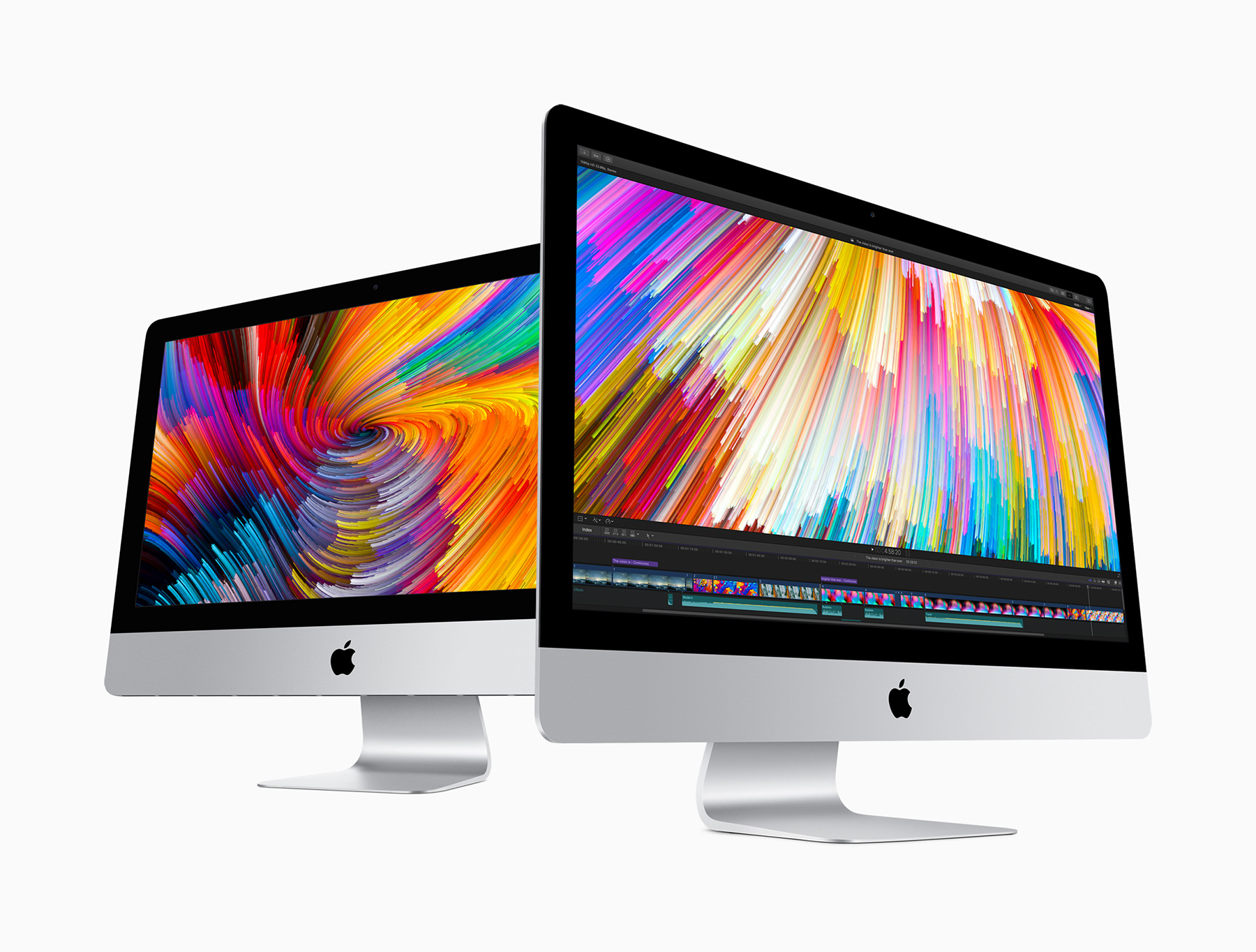
2017 iMacs

When the original iMac went on sale, it was undoubtedly a consumer product. Some professional Mac users mocked the colorful design and lack of legacy ports, unaware that their beloved Power Mac would soon follow in the iMac’s USB-shaped footsteps.

The iMac G4 was also a consumer machine, but it creeped into the workplace slowly, thanks to its incredible design.

The iMac G5 brought the mighty PowerPC G5 CPU to Apple’s all-in-one, which now sported the design we recognize today, with the computer tucked behind the screen. This machine, and the plastic-clad Intel iMacs that followed it got more powerful and more capable over time.

In 2007, when Apple unveiled the first aluminum and glass iMac, Steve Jobs specifically mentioned professional users who were adopting the iMac, saying that the new model was designed with them in mind, in addition to the army of consumers who enjoyed the iMac in their homes.

Many, Many Models

Since then, the iMac line has only grown more broad, stretching from an entry-level machine to one that can handle just about anything.

This breadth means the iMac can fit the needs of users looking for a low-cost family computer to ones who make their living as audio and video editors. There is an iMac for just about everyone.

As of January 2018, these are the stock configurations of iMac for sale on Apple.com:

$1,099

  • 21.5" 1920 x 1080 sRGB display
  • 2.3 GHz dual-core i5 (3.6 GHz Turbo Boost)
  • 8 GB 2133 MHz RAM
  • 1 TB HDD
  • Intel Iris Graphics

$1,299

  • 21.5" 4K P3 Retina display
  • 3.0 GHz quad-core i7 (3.5 GHz Turbo Boost)
  • 8 GB 2400 MHz RAM
  • 1 TB HDD
  • Radeon Pro 555 with 2 GB video memory

$1,499

  • 21.5" 4K P3 Retina display
  • 3.4 GHz quad-core i7 (3.8 GHz Turbo Boost)
  • 8 GB 2400 MHz RAM
  • 1 TB Fusion Drive
  • Radeon Pro 560 with 4 GB video memory

$1,799

  • 27" 5K P3 Retina display
  • 3.4 GHz quad-core i5 (3.8 GHz Turbo Boost)
  • 8 GB 2400 MHz RAM
  • 1 TB Fusion Drive
  • Radeon Pro 570 with 4 GB video memory

$1,999

  • 27" 5K P3 Retina display
  • 3.5 GHz quad-core i5 (4.1 GHz Turbo Boost)
  • 8 GB 2400 MHz RAM
  • 1 TB Fusion Drive
  • Radeon Pro 575 with 4 GB video memory

$2,299

  • 27" 5K P3 Retina display
  • 3.8 GHz quad-core i5 (4.2 GHz Turbo Boost)
  • 8 GB 2400 MHz RAM
  • 2 TB Fusion Drive
  • Radeon Pro 580 with 8 GB video memory

There’s an iMac model spaced every $200 or $300 apart, each one slightly better in one way or another than its cheaper sibling. It’s easy to justify spending just a little more for a faster CPU or a nicer screen. It’s a pricing tactic Apple does well.

Suggested Improvements

Not everything is roses here, though. The non-Retina iMac ships with a pitiful 5400 RPM hard drive and just two CPU cores. Even the RAM is slower than what’s in every other iMac.

Other than the bag of bones that is the entry-level Mac mini, this is the slowest Mac currently for sale. I have a customer who has one of these computers, and I’m here to report that using it is downright frustrating at times, waiting on that hard drive to catch up.

I am glad there is an iMac for just $1,099; I just wish it had a Fusion Drive in it.

Moving up the line, every stock iMac configuration comes with 8 GB of RAM and a Fusion Drive. The RAM isn’t ideal, but I understand why the Fusion Drive has lasted so long. Every Mac comes with 1 TB of storage by default, which is perfect for home users with lots of photos and media. If Apple had to ship 256 GB SSDs to preserve the price point, it would make the iMac experience worse for most users.

Annoyingly, the maximum size for the optional SSD is limited by the standard SKU you start with. The $1,099 iMac can only have a 256 GB SSD, the $1,299 a 512 GB module. To have 1 TB of SSD storage in a 21.5-inch iMac, you have to start with the $1,499 model. These restrictions aren’t present on the 27-inch models.

King of the Hill

Just for kicks, I configured the most expensive 27-inch iMac I could on Apple’s website. This is what $5,299 will get you:

  • 27" 5K P3 Retina display
  • 4.2 GHz quad-core i7 (4.1 GHz Turbo Boost)
  • 64 GB 2400 MHz RAM
  • 2 TB SSD
  • Radeon Pro 580 with 4 GB video memory

This machine is a big jump over the most expensive stock configuration, which makes me think Apple could offer a SKU with an i7 and SSD as standard at the top of the line.

Of course, at $5,299, you should just order an iMac Pro instead…

On Facebook, Twitter and Responsibility ⇢

Joel Spolsky, on Facebook and Twitter:

Both Twitter and Facebook’s selfish algorithms, optimized solely for increasing the number of hours I spend on their services, are kind of destroying civil society at the same time. Researchers also discovered that the algorithms served to divide up the world into partisan groups. So even though I was following hundreds of people on social networks, I noticed that the political pieces which I saw were nevertheless directionally aligned with my own political beliefs. But to be honest they were much… shriller. Every day the Twitter told me about something that The Other Side did that was Outrageous and Awful (or, at least, this was reported), and everyone was screeching in sync and self-organizing in a lynch mob, and I would have to click LIKE or RETWEET just to feel like I had done something about it, but I hadn’t actually done anything about it. I had just slacktivated.

What is the lesson? The lesson here is that when you design software, you create the future.

If you’re designing software for a social network, the decision to limit message lengths, or the decision to use ML to maximize engagement, will have vast social impact which is often very hard to predict.

As software developers and designers, we have a responsibility to the world to think these things through carefully and design software that makes the world better, or, at least, no worse than it started out. And when our inventions spin out of control, we have a responsibility to understand why and to try to fix them.

On Removing the Facebook iOS App ⇢

Miriam Kramer at Mashable uninstalled the Facebook app from her iPhone:

The initial desire to delete started with Facebook vacuuming up so much space and battery life on my (admittedly old) iPhone 6. But it quickly became clear that my actual, non-battery, capital-L Life was also better off not having Facebook a thumbtap away.

I don’t miss it. I don’t miss the weird sensation of unnecessary updates from ex-boyfriends and other assorted once-familiars. I don’t miss having my train time hijacked by being caught up in the political fights (or the rage-inducing comments that followed them).

I also don’t feel like I’m missing out on any kind of news at all, because let’s be honest, Facebook’s days of providing news of actual use are long behind it.

I like this. Like Kramer, I do not have the app installed, and so rarely visit it in Safari, I often forget I have an account. I really only do for work purposes, anyway.

Connected #175: The Devil on my Shoulder ⇢

Connected is back:

2018 is here, and so is Stephen’s new computer and our predictions for the next year. Also, CES is a thing.

My thanks to our sponsors for this week’s episode:

  • Linode: High performance SSD Linux servers for all of your infrastructure needs. Get a $20 credit with promo code ‘connected2018’
  • Squarespace: Make your next move. Enter offer code WORLD at checkout to get 10% off your first purchase.
  • MissionU: An education for the 21st century

RSS Sponsor: CardioBot ⇢

Your Apple Watch measures your heart rate every 4 minutes during the day. With CardioBot, you can easily understand the data captured by the Apple Watch so you can improve your lifestyle and discover notable patterns.

RIP, John Young ⇢

Late last week, American astronaut and all-around badass John Young passed away at the age of 87.

Young’s 42-year career at NASA is unique; he flew two Gemini missions, served as the command module pilot on Apollo 10 then walked on the moon as part of Apollo 16.

In 1973, he was named Chief of the Space Shuttle Branch of the Astronaut Office and was then promoted to Chief of the Astronaut Office a year later.

In 1981, he commanded the maiden flight of the space shuttle aboard Columbia. The shuttle was too complex to be flown uncrewed; the first test flight required two astronauts to put their lives on the line. The flight went smoothly, and Young made history again by the being the first person to land the space shuttle back on Earth.

Two years later, Young was the commander for STS-9, the shuttle mission that carried the first Spacelab module to orbit.

After the Challenger disaster in 1986, Young was publicly critical of NASA management. He wouldn’t fly another mission, and was assigned the roll of assistant director of Engineering, Operations and Safety at Johnson Space Center. He remained in management at JSC until his retirement.

Development of Transmit for iOS Ended ⇢

Cabel Sasser at Panic, announcing that their FTP client for iOS is coming to an end:

Transmit iOS made about $35k in revenue in the last year, representing a minuscule fraction of our overall 2017 app revenue. That’s not enough to cover even a half-time developer working on the app. And the app needs full-time work — we’d love to be adding all of the new protocols we added in Transmit 5, as well as some dream features, but the low revenue would render that effort a guaranteed money-loser. Also, paid upgrades are still a matter of great debate and discomfort in the iOS universe, so the normally logical idea of a paid “Transmit 2 for iOS” would be unlikely to help. Finally, the new Files app in iOS 10 overlaps a lot of file-management functionality Transmit provides, and feels like a more natural place for that functionality. It all leads to one hecka murky situation.

Was the use case for this app too edge-casey or advanced? Did we overestimate the amount of file management people want to do on a portable device? Should we have focused more on document viewing capabilities? Maybe all of the above?

Here’s David Sparks on the matter:

For a few years now Panic has made public statements about how little income they’re making off their pro-level iOS apps, and I really can’t blame them for pulling Transmit if it is losing them money.

What is even more upsetting is that an app of the calibre of Transmit for iOS is a financial failure and none of us are much surprised. There are so many iPads and iPhones out in the world. Granted not everyone will need a world-class file sharing app, but enough should need it that an app like Transmit for iOS can flourish.

Sparks goes on to discuss the App Store ecosystem and its possible role in Transmit’s demise, and I think he’s right. Mac software titles can — and do — demand higher prices than on iOS. Clearly in this case, that wasn’t sustainable.

At MacStories, John Voorhees took a more optimistic approach:

I’m sad to see Transmit go. It’s a loss for the platform, but I don’t think it’s a bad omen for ‘pro’ iOS productivity apps in general. Transmit failed to get the traction necessary to sustain its further development, but there are still many examples of productivity apps that have found success on the App Store. Hopefully, Panic will find a way to bring Transmit back to iOS one day.

With apologies to John, I can’t help but see this is a bad omen for the iOS productivity scene. An FTP client may not be as exciting as whatever the hot GTD app of the year may be, but it’s the type of app that signals stability. FTP clients are used by nerds, and I don’t think many nerds are using iOS as their primary devices.1

This certainly puts a real dent in some of my workflows. Every time I need to move an edited podcast from Dropbox to our host and I’m on the go, I’ve been able to do it with Transmit. There are other ways to get this done on iOS, but Panic’s way was the best. Losing best-in-class apps isn’t good for any platform.


  1. I am real close to two of them, but many of us still prefer the Mac. A lack of a super polished FTP app isn’t going to help things. ↩︎