
Steven Troughton-Smith has written an epic blog post, tracing the evolution from NeXTSTEP to Mac OS X through the lens of Mail.app.
512 Pixels
Connected #244: This is Not Propaganda ⇢
Myke keeps dropping his phone, Apple keeps releasing new MacBook Pros for Stephen to talk about, and Federico has published a magnum opus on the state of the iPad and iOS 12.
My thanks to our sponsors:
- Backblaze: Unlimited cloud backup for Macs and PCs for just $6/month.
- Freshbooks: Online invoicing made easy.
- TextExpander, from Smile: Try the new release with the visual editor. Get 20% off your first year.
Apple Announces WWDC Keynote for June 3
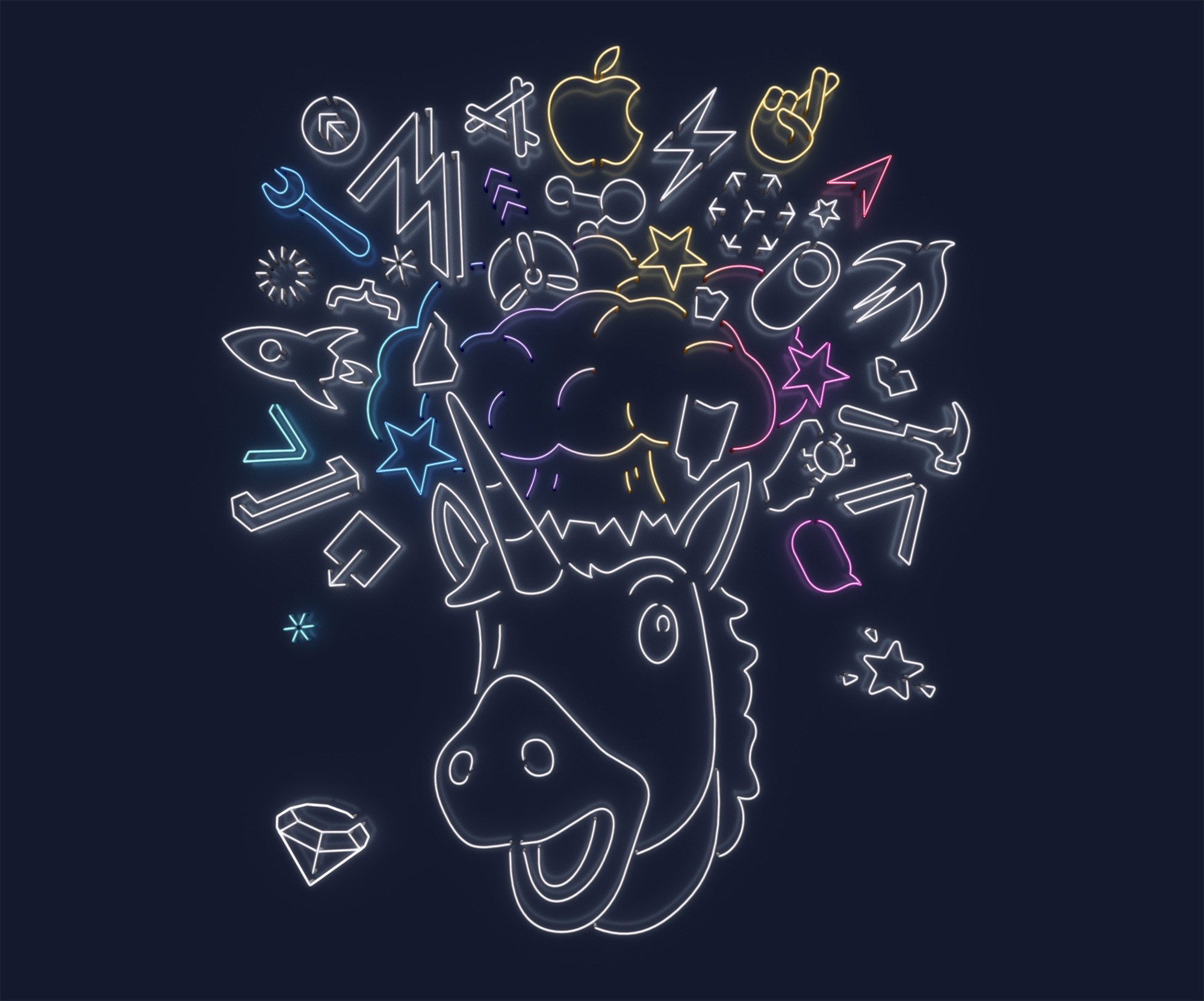
Apple has officially sent out details for this year’s event. I am very excited to say that I will be attending the keynote; this neon unicorn’s face sums up how I feel right now:
Relay FM 5th Anniversary Live Show ⇢
Exciting stuff going on here at Relay FM HQ:
Join us in celebrating Relay FM’s 5th birthday with a special live show featuring some of your favorite podcast hosts for what the kids call a podcasting extravaganza!
The live show will be in San Francisco on August 22. More information and tickets here.
And just check out this artwork!
Vignette Makes Updating Contact Photos Easy and Secure ⇢
After months of teasing, Casey Liss has shipped Vignette, a new iPhone app for keeping your contact images updated easily.
Here’s a bit from his blog post announcing the app, about why he wrote it:
As with all ideas, it starts with a question:
Could I get new pictures for all my contacts on my iPhone off Gravatar?
That was early February. I was just goofing off, and just seeing if I could make that work at all.
Then more questions came:
Could I do this for Twitter as well? For Instagram? For Facebook?
About three months later, Vignette is here.
The idea is brilliant, and brilliantly simple. People upload new avatars to websites all the time; why shouldn’t they be easily added to someone’s contact database? No one should live with all their contacts being represented by their initials. We’re not animals.
This is a very specific problem, and I think Casey’s app handles it supremely well.
The best part is that Vignette is private. It doesn’t need to log in to your social media accounts, or even know if you have an account on a specific platform or not. It crawls your local contacts database, then tries to match the people there with accounts online.
After its search is complete — which took a minute or two on my 693 contacts — Vignette presents you with a list of all the possible changes, allowing you to tell the app which contacts you want to update, and those you don’t, as seen in this screenshot, which I stole from Casey’s blog:
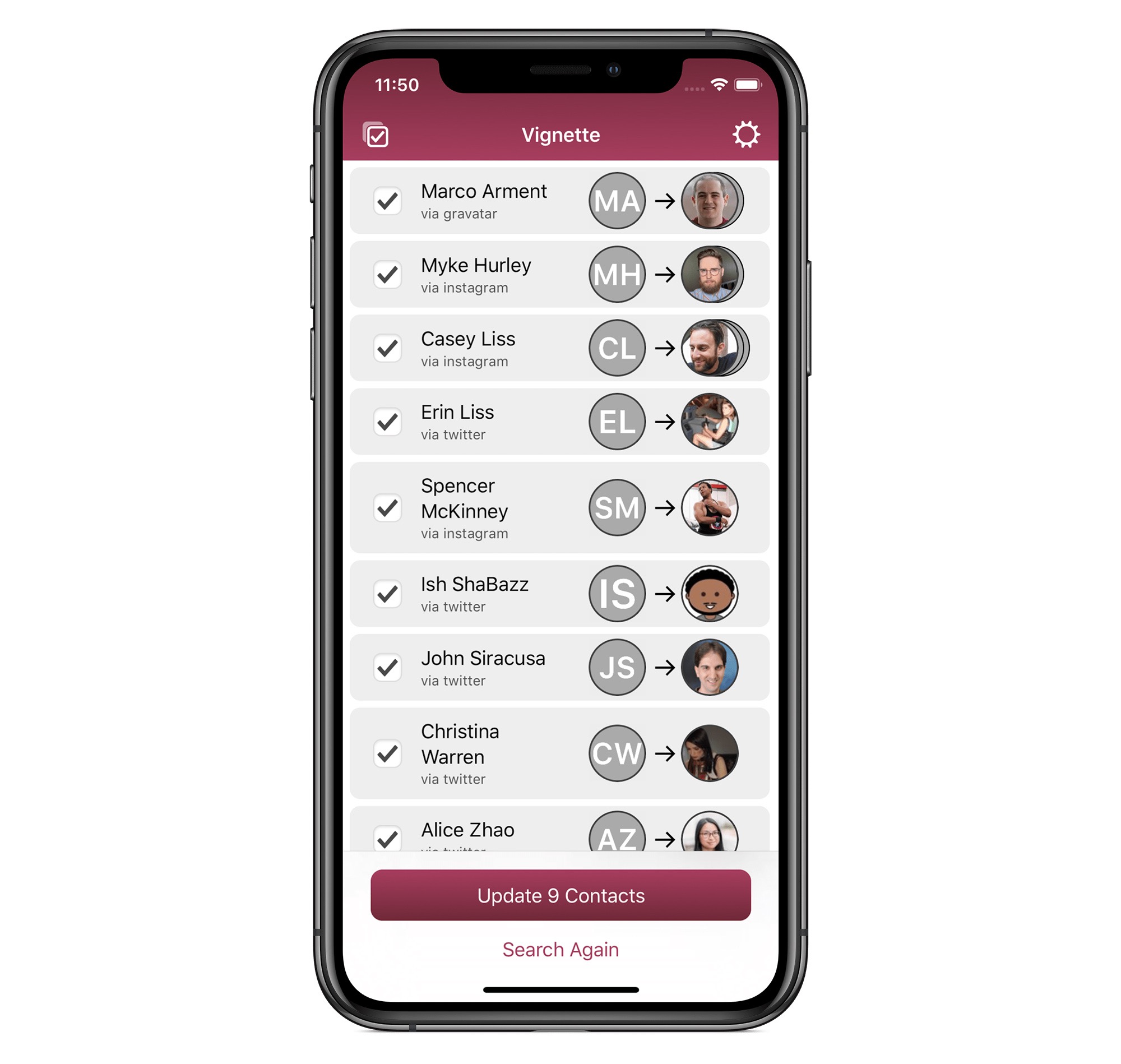
I have a handful of people in my contacts list with photos I set for them, and I didn’t want to overwrite those. Vignette considers that, and makes managing these changes easy.
For me, Gravatar was the source of most of the new images in my contacts, but if I spend a little time adding people’s Twitter, Facebook or Instagram links to their address book entries, Vignette could pull their images from those services as well.
According to Casey’s blog post, here are the fields Vignette looks for:
- Email used for Gravatar
- A custom network called Instagram
If you want more details on how the app works, check out Ryan Christoffel’s review on MacStories, but honestly, you should just go download Vignette now.
Vignette is free, with a one-time in-app purchase of $4.99 to write changes to your contacts database. This means that you can download and run Vignette to see how many contacts it will be able to change, and then decide if you want to move forward with the purchase. I think Casey absolutely nailed that interaction, and I hope the business model serves the app well.
My only complaint is seeing how I’ve aged in the last few years, but that’s not really Casey’s fault.
Probably.
mine was even more dramatic. 0 to 60 on that beard. pic.twitter.com/bIdRpAFZEy
— Ed Cormany (@ecormany) May 22, 2019
Liftoff #99: Apollo 10 ⇢
This time on Liftoff, Jason and I continue our series marking the 50th anniversary of each Apollo mission:
In May 1969, Tom Stafford, John Young and Gene Cernan took their Apollo spacecraft within 48,000 feet of the lunar service.
Come for the views of the lunar surface, stay for the floating poop and weird space music.
My thanks to our sponsors:
- Squarespace: Make your next move. Enter offer code LIFTOFF at checkout to get 10% off your first purchase.
- ExpressVPN: High-Speed, Secure & Anonymous VPN Service. Get 3 months free with a 1-year package.
Apple Introduces Updated MacBook Pros, Extends Keyboard Service Program ⇢
Apple has updated the MacBook Pro today, just two weeks before WWDC. Jason Snell has details:
These updates don’t bring any changes to the exterior of the MacBook Pro—it’s the same base design introduced in late 2016—but they do bring 9th-generation Intel processors with up to eight cores to the MacBook Pro for the first time. There’s also been yet another tweak to the controversial butterfly keyboard Apple first introduced in 2015.
On the CPU front, the 13-inch MacBook Pro with Touch Bar has received a slight speed bump, but it is still using 8th-generation Intel quad core processors.
The models without the Touch Bar are still using older 7th-gen CPUs, as before, and like that machine, the 12-inch MacBook has gone another release cycle without an update.
The 15-inch got a bigger update, as outlined in Apple’s press release:
The 15-inch MacBook Pro now features faster 6- and 8-core Intel Core processors, delivering Turbo Boost speeds up to 5.0 GHz, while the 13-inch MacBook Pro with Touch Bar features faster quad-core processors with Turbo Boost speeds up to 4.7 GHz.
- $2399: 2.6 GHz 6-core i7 (4.5 GHz Turbo Boost)
- $2799: 2.3 GHz 8-core i9 (4.8 GHz Turbo Boost)
- Configure-to-order option: 2.4 GHz 8-core i9 (5 GHz Turbo Boost)
I really like my 2018 13-inch MacBook Pro, but these are tempting.
All of the updated models come with a new, yet-again-revised-but-not-replaced butterfly keyboard. Again, Snell:
Apple says these new models also feature another change (I think this is the fifth?) to the butterfly keyboard in response to customer complaints that the keyboard would end up in a sad state where key presses were ignored or doubled. While Apple is quick to say that the vast majority of MacBook Pro customers haven’t experienced any keyboard issues, the company still keeps tweaking this design. It claims that the change made in these new MacBook Pro models will substantially reduce the incidence of ignored or doubled characters.
To address the problem, Apple said they changed the material in the keyboard’s butterfly mechanism that should substantially reduce issues that some users have seen.
We’ll see how that turns out, but there is good news: Apple has extended its Keyboard Service Program to cover all machines with butterfly keyboards including the 2018 and brand-new 2019 notebooks.1
I can’t remember another time when Apple introduced a product and on day one, it was part of a repair extension program. It’s the right call for users, but damn.
-
2018 machines will receive the new 2019 keyboard if/when repaired under the program. ↩︎
The MacSparky Keyboard Maestro Field Guide ⇢
David Sparks has launched his new Field Guide, a video course all about Keyboard Maestro.
Keyboard Maestro is one of those applications that can really make a Mac sing, but it can be a bit intimidating at first. In this course, David walks through its features in an easily-digestible way. I haven’t used Keyboard Maestro in years, and walked away with a much better understanding of this app and how it can make using macOS more efficient. In fact, I’ve installed it and have already created several macros that are helping me work more quickly. If you’re using a Mac as your main computer, this is $24 you will not regret spending.
This coming Sunday’s episode of Mac Power Users is dedicated to Keyboard Maestro, and we chat about what goes into making these Field Guides possible. I’m looking forward to publishing it.
Beyond the Tablet ⇢
After months of work, Federico has published a manifesto of sorts about the working on the iPad Pro:
Seven years after I started (slowly) replacing my MacBook Air with an iPad, my life is different, but one principle still holds true: I never want to find myself forced to work on a computer that’s only effective at home, that can’t be held in my hands, or that can’t be customized for different setups. For this reason, the iPad Pro is the best computer for the kind of lifestyle I want.
However, the iPad is not perfect. And so in the spirit of offering one final update before WWDC and the massive release for iPad that iOS 13 will likely be, I thought I’d summarize seven years of daily iPad usage in one article that details how I work from the device and how I’d like the iPad platform to improve in the future.
In this story, I will explore four different major areas of working on the iPad using iOS 12 system features, third-party apps, and accessories. I’ll describe how I optimized each area to my needs, explain the solutions I implemented to work around the iPad’s software limitations, and argue how those workarounds shouldn’t be necessary anymore as the iPad approaches its tenth anniversary.
I read it over the weekend, and was impressed with just how many different areas of the iPad experience — both software and hardware — that he considers with thoughtful suggestions on how they could be improved. It’s well worth the time will take you to read it.
The Lombard PowerBook G3 (Bronze Keyboard)
This week marks the second anniversary of the 512 Pixels Membership. To mark the occasion, I am sharing this article, which was sent in this month’s members-only newsletter. To learn more and sign up, visit this page.
Today, the vast majority of Macs sold are notebooks, and as we Mac nerds eagerly await a redesigned MacBook Pro, it’s easy to forget just how far Mac notebooks have come over the years.
In May 1999, Apple introduced the “PowerBook G3 (Bronze Keyboard)” which was an update to the black, curvy notebooks of the day. True to its name, it shipped with semi-transparent bronze keys that exposed the keyframes underneath under direct light.
 Technically, that is a photo of my “Pismo” PowerBook G3, but the keyboard color is the same on both machines.
Packing a 1024 x 768 14.1-inch display, this machine — nicknamed “Lombard” — was a full two pounds lighter than its predecessor, coming in at 5.9 pounds.
Inside was a 333 MHz PowerPC G3, with a 400 MHz CPU as an option for those willing to spend more. It had a memory cap of 384 MB of RAM and came with 8 MB of graphics memory, thanks to the ATI Rage LT Pro. However, this G3 had a slower Level 2 cache, making the old machine faster under certain workloads.
Awkward.
The Lombard, like other PowerBooks of the era, had two bays, one under each side of the keyboard. This allowed users to swap in modules like optical drives and even a second battery, for a potential 16 hours of battery life. The slid and locked into place until ejected by pulling a small plastic lever. It would never fly with today’s Apple, but it made the PowerBook G3 line of notebooks extremely customizable.

This particular generation of PowerBook G3 is special. It was the first to come with USB ports, shedding the ADB and serial ports found on the previous machine.
(The next generation, dubbed the “Pismo” would add FireWire 400.)
This port change no doubt upset some long-time Mac users, but it means that the Lombard was a bridge to the future. Inside, there were more changes, as it was the last PowerBook with built-in SCSI support and the first with a New World ROM.
As with many Macs of this era, the Lombard can run a wide range of operating system. In this case, anything between Mac OS 8.6 to Mac OS X 10.3.9.
The Lombard was for sale for less than a year, and about 18 months after it was announced, the Titanium PowerBook brought the G4 to Apple’s notebook line. As such, it’s basically a forgotten Mac, but one that was an important step in moving the Mac forward.
Review: Timery Improves Toggl Time Tracking in Every Way ⇢
2019 has brought a lot of changes to my workload. I joined Mac Power Users, which radically changed how my work week looks, bringing to an end to a couple of projects and requiring changes to others.
I knew that to make informed decisions about my time as an indie, I needed data. Your gut will always be wrong about how you think you spend your time, but raw numbers don’t lie.
For time tracking, I turned to Toggl. It’s a robust time-tracking platform with apps on the web, Mac and iOS, and the free plan was more than enough to meet my needs.
To begin, I made a list of all the different categories a single task could fall into. My list is long, but broad enough for my needs.
Relay FM
- Relay Admin
- Relay Development
- Relay Membership
- Relay Travel
- Connected
- Download
- Liftoff
- MPU
- Ungeniused
- Other Shows
512 Pixels
- Blogging
- 512 Membership
- YouTUbe
Hackett Technical Media
- LLC Admin
- Consulting
- Freelance Writing
Misc.
Setting all this up in Toggl was easy enough, but the service’s apps are a little … lacking. I run the website as a Fluid app but on iOS, Toggl’s official app is seriously bad. Just this month, they shipped their first iPad version. Yikes.
Enter Timery, a new iOS app by Joe Hribar: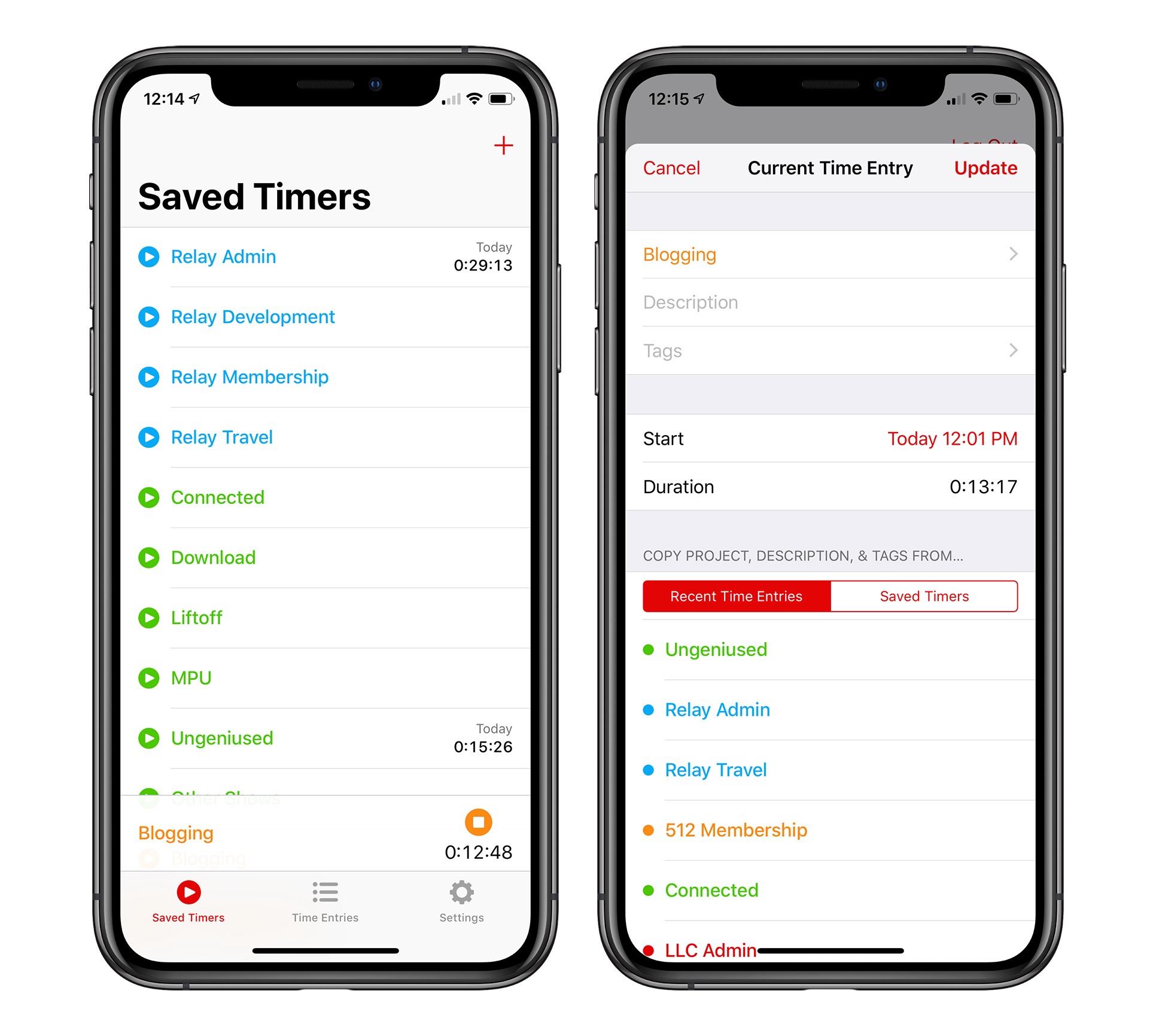
Once logged into Toggl with Timery, the app syncs seamlessly — and shockingly quickly — with the service. I’ve stopped a timer on my phone to see it stop in the web browser instantly. As far as apps that sync with web services, Timery earns a gold medal.
It doesn’t end there, though. Timery’s design is far better than Toggl’s, and the app comes with a bunch of goodies including a widget, a nice dark mode, a customizable homescreen icon and Siri support for starting, stopping and checking on timers.
Many of these features are unlocked via subscription for $9.99/year. If you’re tracking your time, it’s money well spent.
While Timery supports the vast majority of features found in Toggl, there is one that I’d like to see, if possible: reporting. In his review on MacStories, John Voorhees has the same wish I do:
The Toggl web and iOS apps include charts to visualize how you spend your time. Weekly, monthly, and yearly reports can be generated and compared with time logged for earlier periods. If you’re a Toggl subscriber, project-level reports are also available broken down by each project’s tasks. I rely on these reports to give me a sense of what I’m working on relative to other projects and prior periods and see if how I feel about my workload is borne out by the data. It’s the kind of information that allows me to evaluate if I’m working on the right projects and make periodic adjustments. I know this is on developer Joe Hribar’s radar and look forward to seeing what he comes up with in the future.
Even without reports, Timery has earned a place on the homescreen of my iPhone and iPad, and I hope it makes the jump to the Mac sooner rather than later.
-
Anytime I am doing research for something that may end up in columns and podcasts, it goes here. When I’m watching the WWDC keynote in two weeks, this will be the timer that is running. ↩︎
-
This includes running my off-site backups, tinkering with my home network or switching to-do apps. ↩︎
-
I’m on the Board of Directors for Operation Broken Silence, a non-profit run by my brother focused on issues in Sudan. ↩︎
Kbase Article of the Week: Cannot Select GeForce 9400M Graphics in Windows on MacBook Pro (15-inch, Late 2008), MacBook Pro (17-inch, Early 2009), MacBook Pro (15-inch, Mid 2009), and MacBook Pro (17-inch, Mid 2009) ⇢
You may notice that the built-in NVIDIA GeForce 9400M graphics subsystem does not appear in the Device Manager and cannot be used with Microsoft Windows XP or Vista.
Windows is not able to take advantage of the GeForce 9400M graphics processor and by default uses the GeForce 9600M GT discrete graphics processor.