512 Pixels

Connected #204: Tennessee Can’t Get Me ⇢

This week on Connected, Myke and I kick off iPhone and iPad rumor season, then talk through some recent app news and Apple’s cancellation of the App Store Affiliate Program.

It was made possible by:

  • Squarespace: Make your next move. Enter offer code CONNECTED at checkout to get 10% off your first purchase.
  • Linode: High performance SSD Linux servers for all of your infrastructure needs. Get a $20 credit with promo code ‘connected2018’
  • Inboard Technology: Save $100 on your purchase of the M1 e-board with code Connected100.

Patreon Acquires Memberful ⇢

Janko Roettgers, writing at Variety:

Patreon wants a bigger slice of the subscription and membership business: The San Francisco-based startup announced the acquisition of Memberful Wednesday to expand into the realm of white-labeled membership services. Memberful’s entire staff of 7, including its founder Drew Strojny, are joining Patreon as part of the deal. Financial details of the transaction weren’t disclosed.

Here’s a bit from Strojny’s email to customers:

As a Memberful customer, you might be surprised by this news. You might also be concerned about the future of Memberful. Are we giving up? Are we shutting down? Quite the opposite. Memberful has been growing fast, and our growth has even accelerated in 2018. We’re partnering with Patreon to take this to the next level. Patreon brings capital, expertise, and resources that will help us make Memberful even better for you.

This is backed up in Patreon’s announcement:

The Memberful platform and brand will remain independent, the current product roadmap will continue at a faster pace, and existing creators using Memberful will not experience any immediate changes to the service. The Memberful team will continue supporting independent creators and building the Memberful service as part of Patreon. As it will operate as a wholly-owned subsidiary of Patreon, Memberful currently has a different pricing model than Patreon that is built around three tiers which will remain unchanged for existing customers.

It seems that Patreon believes Memberful can help them reach creators that couldn’t otherwise, and are going to keep Memberful alive and well. This is expanded upon in an interview by Ben Thompson with Strojny and Jack Conte, the CEO of Patreon. Here’s Conte:

…there’s a whole segment of the market that doesn’t want to build a membership business on someone else’s platform, they want full control of the branding, they want full control of the experience. Right now Patreon is unable to serve that market, if we were to build that, it would be a completely separate thing. Working with the Memberful team accelerates us into that market segment, so it gives us a very big head start. I would say mostly that’s where the value is.

There’s also the idea of focus and learning. This is a way for us to start learning about that segment right out of the gate, and not only that, but also acquire a team that has so much organizational knowledge and understanding of that segment and what they need and what they want.

The biggest thing is pretty simple: there’s a market segment that we are unable to serve right now, and Patreon’s mission is to fund the creative class. That’s not a small thing: we want to serve all creators, all creative people who are putting things either online or even in person, and this is a way to accelerate our progress to our mission.

I wasn’t shocked by the news. Memberful is a great product, but isn’t a huge company. In fact, according to TechCrunch, it has only about 500 paying users. As you may know, We use Memberful for the Relay FM membership. As such, I approach this news with two thoughts.

First, if this lets Memberful continue to grow and expand, that’s good for everyone who uses it. The acquisition does come with a price increase for new customers, and I hope that doesn’t slow growth. A healthy Memberful means it is more likely to stick around and not be absorbed into Patreon.

That brings me to my second thought. I would consider moving to Patreon if I had to, but the company has no shortage of mistakes across its history, including payment processing issues and walked-back fee changes. I want to believe that Memberful won’t inherit these types of issues, but it’s something worth watching.

I’ve had several conversations with Strojny and his team over the years, and I’ve always been impressed with how they ran their business. It’s why I do business with them, and it’s why I am willing to see how this goes.

Kbase Article of the Week: Definition: Beta Software, Beta Test ⇢

Apple Support, channeling the dictionary:

Beta is a term used to describe software that is in the last stage of testing. Software publishers frequently make beta software availabile [sic] to a limited audience so that it can be tested in real-world environments. This is called a beta test.

Because beta software may be incomplete, it may not function correctly all of the time. You should only install beta software if you know how to remove it, or how to troubleshoot errors it may cause. Before installing any beta software, be sure you have a backup of important files you want to keep.

25 Years Ago, Apple Introduced the Newton

I’ve rounded up some links to mark the occasion:

Happy birthday, Green Machine.

‘I Don’t Really Think About It’ ⇢

This morning, Apple became the first American company to reach a $1 trillion market cap.

Mark Gurman has a piece up about it:

Apple was worth about $350 billion when Jobs died, so Cook has led the creation of even more stock-market value than his former boss and mentor. Bloomberg News asked him about the $1 trillion target in a February interview.

“I don’t really think about it,” he said, suggesting that if the company keeps making successful products, financial success will follow. “I still view Apple as a pretty small company, the way that we operate. I know it’s not numerically, but the way we function is very much like that.”

I haven’t owned Apple stock since I worked in Apple Retail, and don’t cover Apple’s financials very closely. Even so, it’s hard to not smile when I see something like this:

LOL pic.twitter.com/Z0Z0c2CaEs

— Businessweek (@BW) August 2, 2018

Apple Removing iOS and Mac Apps from Affiliate Program

Apple:

With the launch of the new App Store on both iOS and macOS and their increased methods of app discovery, we will be removing apps from the affiliate program. Starting on October 1st, 2018, commissions for iOS and Mac apps and in-app content will be removed from the program. All other content types (music, movies, books, and TV) remain in the affiliate program.

This is not totally surprising after Apple cut the rate for in-app purchases last year. However, this is going to hurt a lot of people in the media ecosystem around Apple.

Eli Hodapp at TouchArcade:

I genuinely have no idea what TouchArcade is going to do. Through thick and thin, and every curveball the industry threw at us, we always had App Store affiliate revenue- Which makes a lot of sense as we drive a ton of purchases for Apple. I don’t know how the takeaway from this move can be seen as anything other than Apple extending a massive middle finger to sites like TouchArcade, AppShopper, and many others who have spent the last decade evangelizing the App Store and iOS gaming.

Of course, some have planned ahead. Federico Viticci on Twitter:

Apple killing the affiliate program for apps feels downright hostile and petty.

I am personally not that affected because we saw this coming years ago and we adapted – but it’s a huge blow to small publications, indie devs, and others who rely on this to earn commissions. Sad.

Shawn Blanc, writing at The Sweet Setup, where I used to serve as Editor:

About a year ago, Apple made a somewhat similar change to the affiliate program but then backtracked on their plan.

However, we took that as the writing on the wall that the affiliate program was not going to be a long-term, reliable source of revenue. And now, a year later, it turned out to be true.

Over the past year we have been focusing heavily on creating our own products to serve you, our readers, directly. And as a result, The Sweet Setup is not dependent on affiliate revenue. (Nor advertising revue either, for that matter.)

And so, thankfully, for us, nothing will be changing.

Perhaps I’m being crankier than I should be, but the tone of Apple’s email really bugs me:

With the launch of the new App Store on both iOS and macOS and their increased methods of app discovery, we will be removing apps from the affiliate program.

I can’t help but feel that Apple is waving off the wide array of sites that help consumers find apps as being unnecessary in light of Apple’s new editorial content within the App Store. I simply don’t believe that to be the case. The App Store is massive, and the crop of websites that have come to make a name for themselves comparing and reviewing apps add value to the ecosystem.

Another angle here to consider is money. Payments made to people linking to apps with affiliate links comes out of Apple’s share of revenue generated by app sales and in-app purchases. How much money it costs them is unknown, but the idea that the reasons behind this move could be financial in nature feels pretty gross. Apple is a for-profit company, and it may have a real bottom-line reason to close this program, but sometimes doing the right thing comes with a cost.

Connected #203: Big Fancy Museum Boy ⇢

This week on the show:

Myke is back, and comes with news of a new household robot, while Stephen reflects on his Macs, both old and new.

My thanks to our sponsors:

  • Hover: Show the world what you’re passionate about with 10% off your first purchase
  • Pingdom: Start monitoring your websites and servers today. Use offer code CONNECTED to get 30% off.
  • Inboard Technology: Save $100 on your purchase of the M1 e-board with code Connected100

How to Set up Time Machine Server

Note: If you are using macOS Ventura or later, check out the updated version of this article.


It used to be that to run a Time Machine Server, you needed to be running a copy of macOS Server on your host machine, but those days are now gone. Anyone running High Sierra or later on a Mac can now turn that Mac into a destination for remote machines to use for Time Machine.

Say you have a Mac mini on your network, and a MacBook Pro. You can hook up an USB hard drive to that Mac mini, and within a few minutes, be backing your MacBook Pro up across your network using Time Machine.

Here’s how to do it.

1. Prepare Time Machine Drive

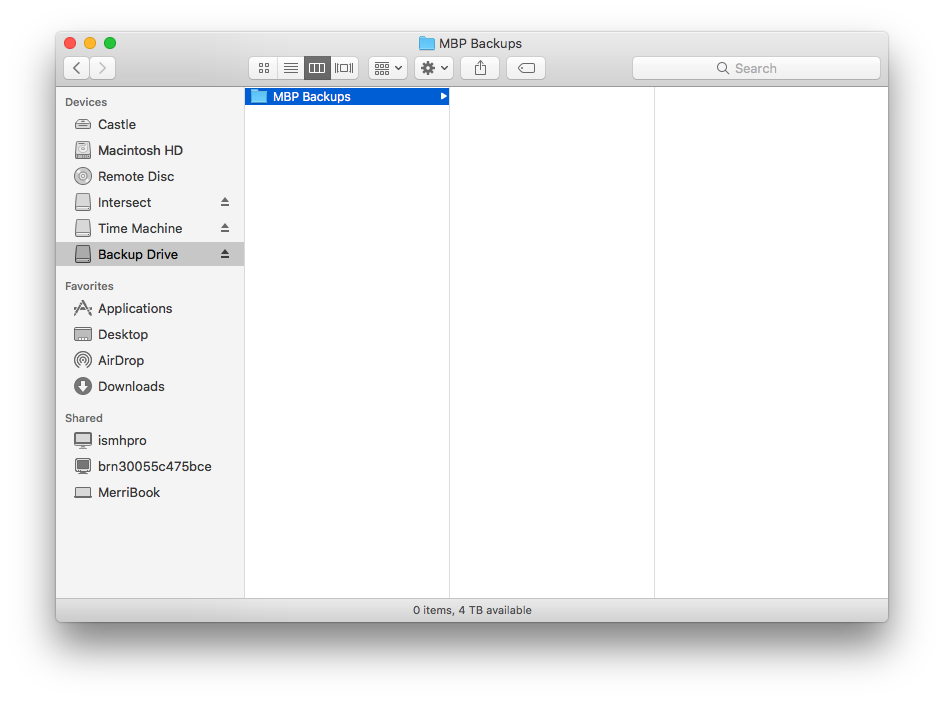
The drive I am using came formatted for Windows, so I took a quick trip to Disk Utility to format it in HFS+, naming it “Backup Drive”. APFS may be the default for Time Machine drives at some point, but today is not that day. 2021 Update: APFS is here!

Then, I created a folder on the root level of the hard drive named “MBP Backups,” just to keep things neat on the drive.

2. Share the Drive Using System Preferences

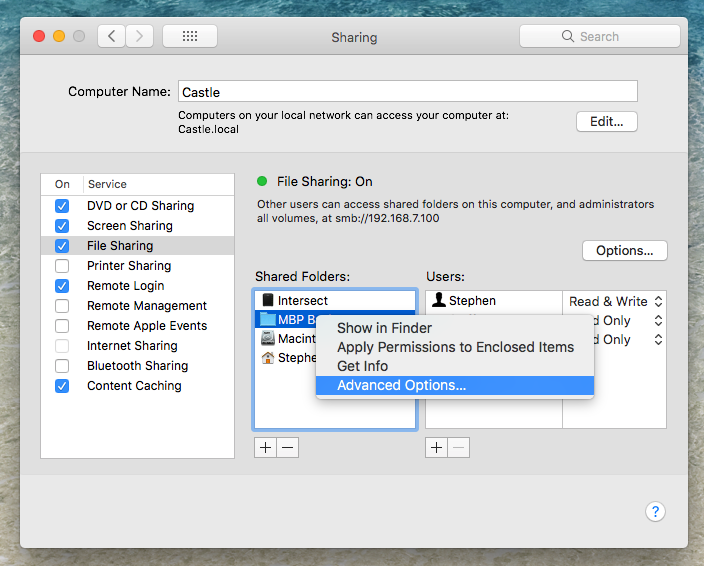
Once the drive is ready, navigate to the Sharing pane in System Preferences. Hit the small + button below the Shared Folders list and add your new drive or folder.

Then, right-click on it and select Advanced Option…

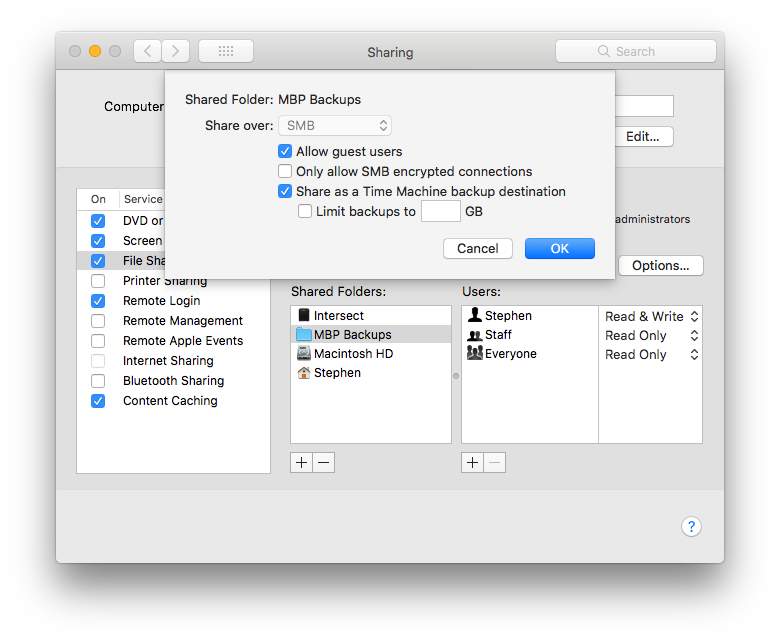
In the new window, enable the drive for use as a Time Machine Backup Destination. If you wish to cap the size that the backups can take, you can do so here as well:

If not, Time Machine will fill up the entire drive with time.

3. Connect to Remote Folder on Client Mac

In the above example, now is when you would move to your MacBook Pro and connect to that shared folder across the network.

4. Add Folder as Time Machine Destination

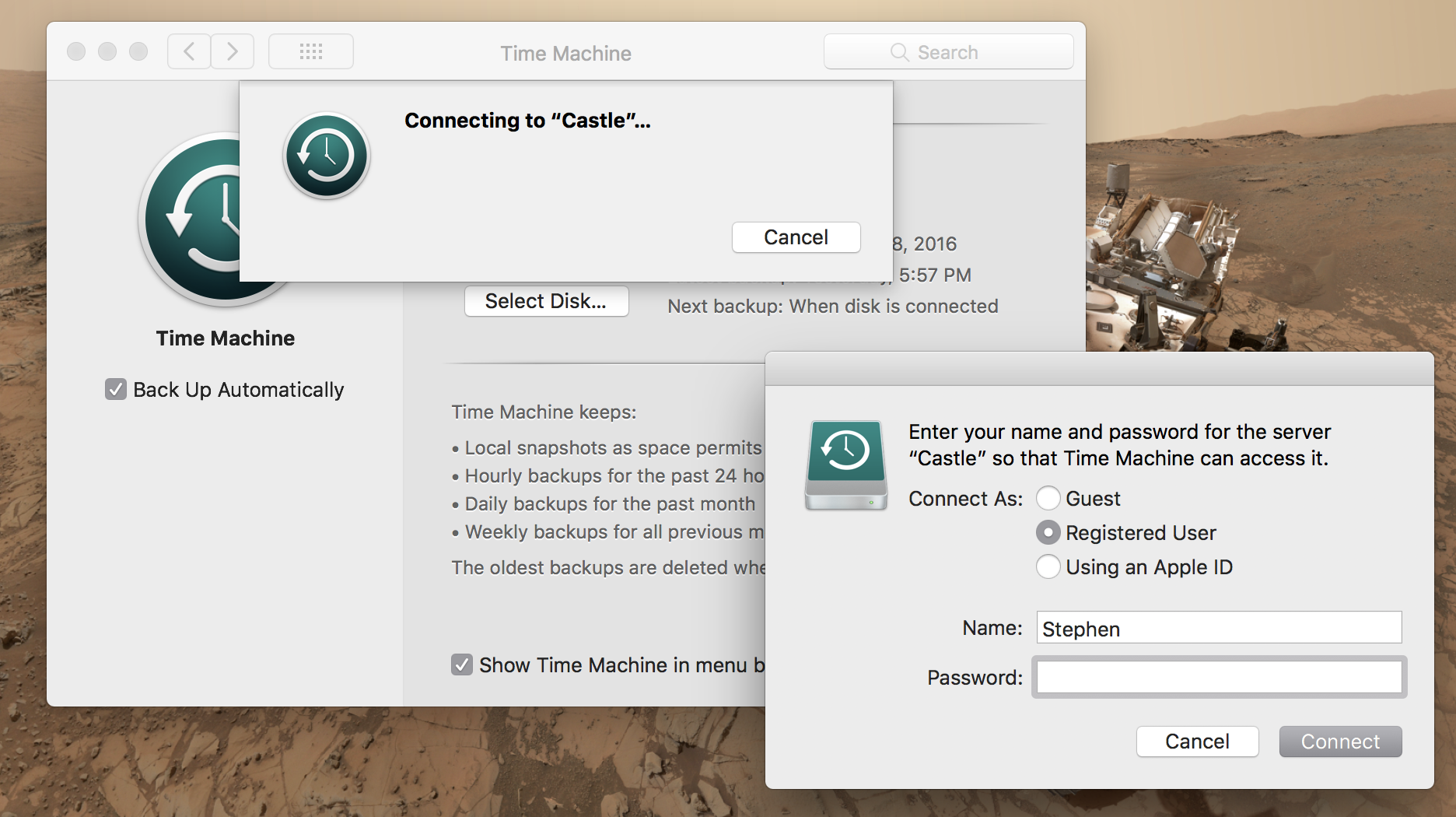
Once the folder is mounted, open the Time Machine pane in System Preferences and add the folder as your backup destination. Once you do, System Preferences will ask for a user name and password for Time Machine to automatically connect to the backup folder when it is available: