512 Pixels

????

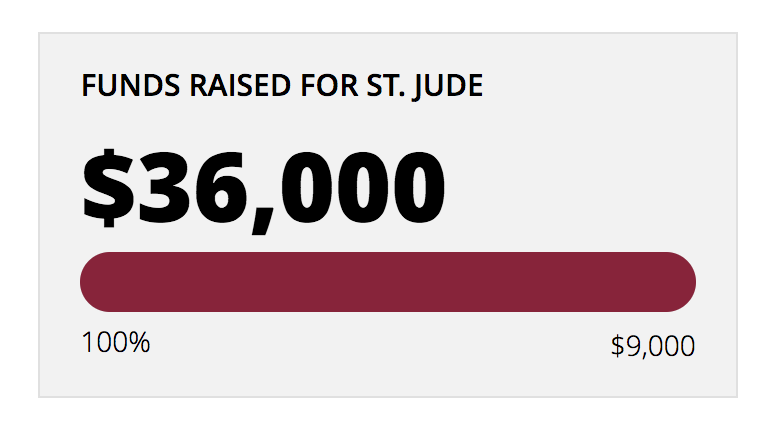
To mark Childhood Cancer Awareness Month each year, I raise money for St. Jude Children’s Research Hospital. I do so via the hospital’s annual marathon.

This year, my oldest two kids — including our St. Jude patient — are running the kids marathon. They’ve been running around the neighborhood with my wife, and will run the last mile in downtown Memphis this December.

We set up a fundraising page with a $9,000 goal; one grand to mark each year of our son’s life. Each one is a miracle.

You, dear Apple community, came out strong this year:

Thank you. It’s a crazy world, and there a thousand good non-profits that need support. You have lots of options, and it means a ton to me that you’ve chosen to rally around this hospital that cares for kids with cancer, all without charging their parents a dime.

SpaceX Looks to Lunar Missions with Mars Still on Musk’s Mind ⇢

The Verge’s Loren Grush:

Today, SpaceX CEO Elon Musk said he hopes to finance his plans to colonize Mars by making SpaceX’s entire fleet of vehicles — the Falcon 9, the Falcon Heavy, and the Dragon spacecraft — obsolete.

Speaking at the International Astronautical Congress, Musk said that SpaceX will eventually start stockpiling these vehicles and then focus all of its resources into developing the company’s next monster vehicle: the Interplanetary Transport System, codenamed the BFR (for Big Fucking Rocket).

The ITS would be capable of sending stuff to low Earth orbit like the company’s Falcon 9 is today, but be scaled up to go the moon or Mars. (Oh, and SpaceX could use the tech to for city-to-city rocket travel here on Earth.)

The former is really interesting. Vice President Mike Pence, who has revived the National Space Council, is widely assumed to push NASA to focus on lunar missions before a trip to the Red Planet. SpaceX enjoys a large NASA contract now, and wants to be in place as a provider for moon missions for the US government, not to other nations and private-sector companies.

Grush continues:

Of course, Musk’s ultimate goal is still Mars, and he’s still making incredibly optimistic predictions about when the company is going to get there. Last year, Musk claimed the first crews would start flying to the Red Planet as early as 2024. This year, he said the first two cargo ITS ships will launch to Mars in 2022. That’s just five years to create an entirely new rocket, send it to another planet, and land it on the surface intact. If it does land successfully, it’ll be the heaviest vehicle to ever make it to the Martian surface in one piece. (The most we’ve ever landed on Mars has weighed about 2,000 pounds, but the ITS can supposedly land between 20 to 50 tons.)

As always with Musk, these timelines are unrealistic, if not downright silly. That aside, SpaceX is clearly thinking beyond low Earth orbit, and that’s probably wise, as NASA is as well.

Pencil Test

In 1988 Apple’s Advanced Technology Graphics Group created a short filmed named Pencil Test to show off the capabilities of the Macintosh II:

The company published two support documents about the film.

Reading this documents is a little wild. The Macintosh II was a modular system, unlike Steve Jobs’ original all-in-one. Apple speaks to both sides of the closed/open coin, claiming they have the best of both worlds: integrated system software and factory hardware with the ability to accommodate modularity at the same time:

There are advantages and disadvantages both to the totally integrated systems and the open modular systems. Totally integrated system’s advantages include having hardware and software tied directly together and having one place to get support. Disadvantages include being locked into the one company’s point of view about how to do things, working only with their tools, and, often, being locked into that company’s software. An integrated solution on non-Macintosh systems is most likely pieced together from a variety of third-party products.

Open module systems offer one of the main advantages of Macintosh: integration. With the Macintosh consistency of user interface, different modules from different publishers have the familiar user interface. The best drawing program can be used with the best animation program while using the best video card.

What’s even more interesting is the company Apple is gunning for in these documents:

Amiga animation and Pencil Test do not compare well. The Amiga solution uses 256 colors/8 bits per pixel, while Pencil Test uses 16,800,000 colors or 24 bits per pixel. Doing the shading used in Pencil Test on an Amiga results in a palette of a few main colors with many shades of those few colors. Also, be aware that many of the video products for the Amiga work at a resolution of 320 x 200 pixels. This is a fairly low-resolution graphics when compared to the Macintosh solutions using a minimum of 640 x 480 pixels. Using a product like RGB/Videolink 1400A, it is feasible to use pixel counts as high as can be purchased; that is, 2048 x 1024, 1024 x 1024, and so on.

Of interest, the developers of the top Amiga animation products are in the process of moving their applications to the Macintosh II. Many have completed the move.

Big thanks to Brian, who emailed me about these kbase articles.

Amazon Unveils new Echo Products ⇢

The new, second-generation Echo is smaller, with better speakers and a design I find far nicer than the first-generation model that currently sits in my kitchen. At $99, it’s cheaper, too. Seems like a win.

The $35 Echo Connect is far stranger. Pitched as a phone replacement, it plugs in to your old analog phone line and lets you make phone calls, including to 911.

Both devices go on sale later this year. I’m excited about the former, but as we stopped paying AT&T for a landline years ago, I’ll pass on the latter.

There is also the Echo Spot, a smart alarm clock and the Echo Plus which doubles as a smart home hub and looks just like the original Echo.

macOS Sierra Removed From Mac App Store

In years past, when a new version of macOS has come out, the previous one would still be available for download in the Mac App Store’s Purchased tab:

No Sierra

This year, Apple has changed its policy, according to this kbase article:

macOS Sierra or later doesn’t appear in the Purchased tab. Instead, use the Search field in the upper-right corner to find and open the App Store page for that macOS.

As Juli Clover at MacRumors points out, it appears that macOS downloads are no longer being tied to a user’s Apple ID. I like this change; I was thought it was a little silly to have to sign in to download a free operating system installer.

However, at least of this writing, macOS Sierra is not in the Mac App Store:
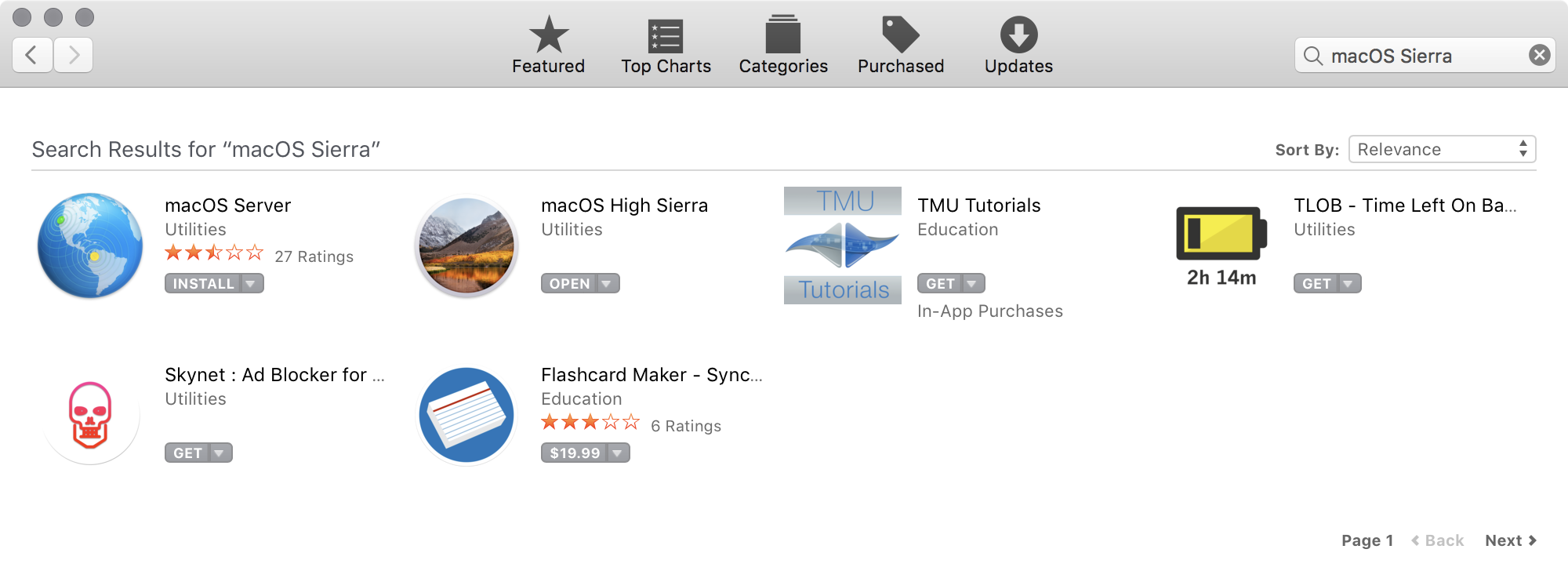
No Sierra here either

It’s not even available via this direct link that worked earlier this week:

If you want to download the macOS Sierra installer, today may be the last day to do that easily. https://t.co/5JtpzQfJAm

— Stephen Hackett (@ismh) September 25, 2017

This means there’s no easy way for someone to install macOS Sierra at this point. If your Mac came with 10.12.4 or greater, you can reinstall that version from Apple’s servers, but going back from High Sierra isn’t doable unless you’ve got a copy of Sierra laying around.

While I find it a little annoying, I acknowledge that not everyone is a pack rat like I am. There could be a few reasons for this.

With the APFS transition, going back to Sierra on Macs with internal SSDs is a rather complicated process that requires the removal of all data from the drive. That’s not for the faint of heart.

Moreover, I think Apple considers 10.13 a better, more true form of 10.12. The company wants everyone running Sierra to move to High Sierra. Removing Sierra from download makes that more likely.

Connected #161: A Handbag? Face Cream? A Chainsaw? ⇢

This week, on a packed episode of Connected:

Files on iOS 11 is taking shape, and some problems are emerging. Federico gets sad listening to the others talk about their watches, then slowly disappears as Stephen talks about macOS High Sierra.

My thanks to our sponsors:

iCloud’s Text Expansion Syncing is Busted ⇢

Brian Stucki:

Text replacement syncing is completely broken. Sometimes it works, sometimes it doesn’t. Sometimes it will only sync back old snippets that you have deleted. Sometimes the sync will work one direction, but not the other. Every time I ask about this on Twitter, it brings a strong response of similar experiences.

Even though I know it’s broken, I decided to get scientific about it.

Two things: First, this is incredible work; click through and see all the work that went into this. Second, Apple really should fix this feature.

Update: I got a note that this is supposed to be much better with iOS 11 and High Sierra. Fingers crossed!

Update 2: Gruber says that this system is being migrated to the much more reliable CloudKit with an update coming to iOS 11 and High Sierra soon. Good news!