
My thanks to Mardo for sponsoring the site this week. It is the best Markdown viewer ever made. Press Space on a Markdown file and watch it render beautifully, live, right in Quick Look.
posts
Connected 626: Droid Does⇢
I am back on the podcast, and just in time:
MacBook Pros can be touched, iPad mini chips can be binned, and John Ternus can change the world.
A Mac for the iPad World⇢
Federico Viticci, in the smartest article I’ve read about the new MacBook Pro:
I’d argue that the Mac’s lack of touch is a liability at this point. Its omission has turned from a deliberate design decision that made sense for its time to a choice dictated by inertia and, perhaps, an unwillingness to challenge the status quo. Which is especially funny since the “status quo” of Apple is that of a company that sells millions of touch-enabled devices every year and considerably fewer trackpad-only ones. The lack of touch on the Mac feels like a self-inflicted problem that has no reason to exist anymore, and which John Ternus is rightfully rectifying for the modern age.
As someone who has spent the past decade working on an iPad, and is now increasingly shifting his workflow to the Mac, I think it’s great that we’re getting touch as an option on the Mac. I’ve always been in favor of hardware that can adapt to the user instead of the other way around.
The MacBook Pro getting touch support feels like another step in the long arc of Apple meeting users where they are – even if it means “contradicting” a quote from 2010. We’re moving on, and it’s about time.
On Bringing Touch to the Mac⇢
Steven Levy got to speak to Apple’s CEO (and others) about the new MacBook Pro with PROLED XDR Display for Wired (Apple News):
I ask if Apple is about to break a long-imposed taboo and introduce a Macintosh with a touch screen.
Ternus beams. “Who knew?”
We are referring to the new MacBook Pro with PROLED XDR Display that Apple is releasing today at an event in Los Angeles. It’s got a mighty M5 Pro or M5 Max chip and a show-stopping tandem OLED screen. (A tandem screen has multiple light-emitting layers, producing more dramatic contrasts.) But its most conspicuous feature is one that’s been deeply woven into iPhones, iPads, and even Apple Watches for years but not Apple’s laptops: a touch display. After years of resistance, a Mac screen has finally gone digital.
As in fingers.
This turnaround is a big deal to Apple fans. Ternus shrugs off the drama. “The Mac is first and foremost an indirect input device, built around the trackpad and keyboard. But I think there’s times when it’s comfortable and handy to have touch.”
MacBook Pro with PROLED XDR Display
Apple just unveiled its new high-end notebook, the MacBook Pro with PROLED XDR Display. The name is a mouthful, but it makes a lot of sense, as the normal MacBook Pro is still alive and well.1
The most important thing about this laptop is that the Apple logo lights up on the lid. I will never forgive Jony Ive and Tim Cook for taking that away ten years ago. I understood it on the 12-inch MacBook in 2015, but taking it off the MacBook Pros was in poor taste.
A Forgotten Apple Network Server Prototype⇢
Thanks to Cameron Kaiser’s excellent blog Old Vintage Computing Research, I have a growing interest in the Apple Network Server line of computers. One of Kaiser’s posts mentions the ANS 300, a model I wasn’t familiar with at the time.
Turns out, it is wild. Tom Owad wrote about it back in 2004:
The Apple Network Servers are high end servers built by Apple that run IBM’s AIX variant of UNIX. Pictured above is the Apple Network Server 700, Apple’s top-of-the-line server with a 180 MHz PPC 604e processor, two power supplies, 7 removable drive bays and 2 fixed drives. The ANS 500 had a slightly lesser configuration, with a 132 MHz 604e, only one power supply, and 7 removable drive bays. Both have locking wheels on the bottom (handy since the unit weighs about 80 pounds!) and a locking/sliding 3-position translucent door to cover the drive bays. The power supplies are removable via a handle behind the purple removable “grille” in the bottom. These units were specifically designed to be highly serviceable yet very secure.
The ANS 300 had the same architecture as the 500 & 700, but was an easily rack-mounted unit intended for Internet/FTP/Mail/Web serving, departmental and small database servers, etc, and consequently had less expansion. It has two removable drive bays and one fixed drive (behind the LCD). Much of the serviceability & security was abandoned for the sake of size. For instance, there is no obvious way to secure the drive bays, or the motherboard tray from being removed. The power supply is fixed and would be slow to field repair. The fixed hard drive mounted behind the LCD is very hard to reach, etc. The key lock on the front controls only the “on, lock, service” options, unlike the multiple key lock controlling those functions plus doors and security on the full size 500/700 units. These issues ceased to be important, however, as the ANS 300 never shipped.
MacBreak Weekly 1048: The Cupertino Coffin⇢
I joined Jason Snell, Andy Ihnatko, and Shelly Brisbin on this week’s show to talk about our iPhone Duo impressions, reports of cracking phones, and Apple’s busy week of releases.
Duo Walk-In Purchases May Work After All
If you are looking for a Duo, you may get lucky at your local Apple Store. I was at mine half an hour before opening, was the first person in line, and one of just three folks who were able to buy one.
I have like 90 minutes of time with it, but uhhhh this phone is weird.
The M6 Rolls into the iMac, Entry-Level MacBook Pro
Same designs as before, now just a good bit faster.
Sponsor: Mardo, the Best Markdown Viewer Ever Made⇢
Do you read Markdown on your Mac? Plans, notes, READMEs, the files your AI writes for you all day? Then why not make every one of them a pleasure to read? Mardo is the best Markdown viewer ever made. Select any Markdown file in the Finder, press Space, and Quick Look shows it beautifully rendered — tables, code, diagrams, math, and all.
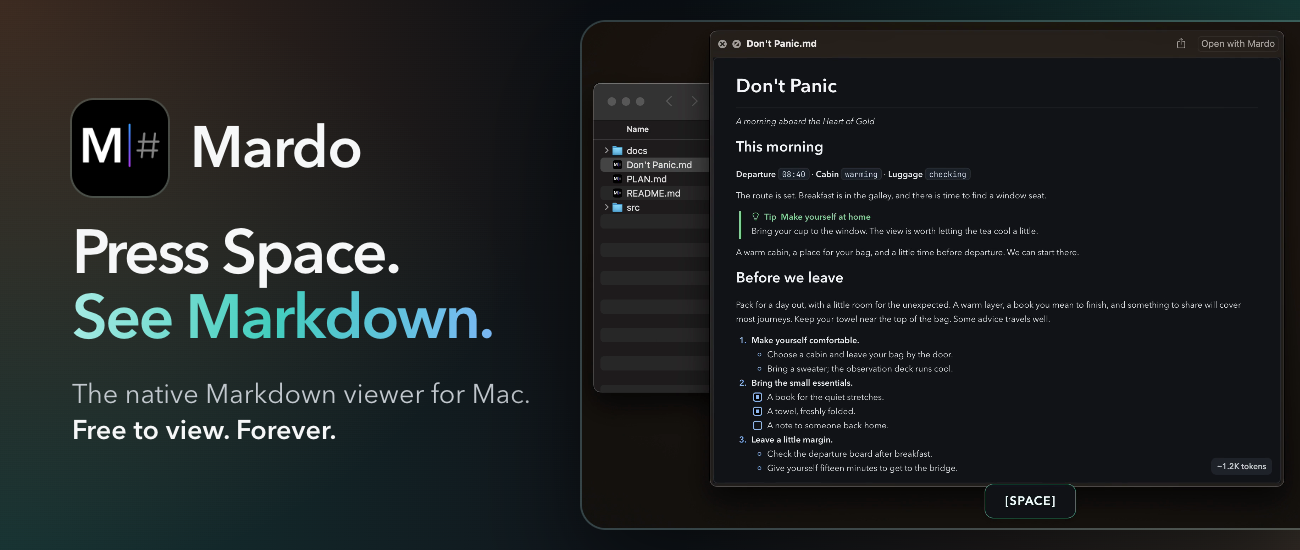
Then watch it come alive. Leave that preview open while Claude Code, Codex, or any other app rewrites the file, and every change arrives in real time, right there in Quick Look, without moving you from the line you were reading. And when a file gets enormous, Mardo doesn’t flinch. It opens a 50 GB Markdown file in about an eighth of a second and lets you jump anywhere in it instantly.
Apple Updates the iPad mini⇢
No ProMotion feels like a miss, but the water and dust resistance is pretty cool.
Hello Again, Ten Years Later
A post from November 2021 titled The 14-inch MacBook Pro Resets the Timeline is one of my favorite things I’ve written in the 18-year history of 512 Pixels. In it, I reviewed the first 14-inch MacBook Pro as if the 2016-era MacBook Pros never existed.
But of course, they did exist, and were announced ten years ago this week. Here’s a bit from Apple Newsroom back on October 27, 2016:
Apple today introduced the thinnest and lightest MacBook Pro ever, along with a breakthrough interface that replaces the traditional row of function keys with a brilliant, Retina-quality Multi-Touch display called the Touch Bar. The new MacBook Pro features Apple’s brightest and most colorful Retina display yet, the security and convenience of Touch ID, a more responsive keyboard, a larger Force Touch trackpad and an audio system with double the dynamic range. It’s also the most powerful MacBook Pro ever, featuring sixth-generation quad-core and dual-core processors, up to 2.3 times the graphics performance over the previous generation, super-fast SSDs and up to four Thunderbolt 3 ports.
The Touch Bar places controls right at the user’s fingertips and adapts when using the system or apps like Mail, Finder, Calendar, Numbers, GarageBand, Final Cut Pro X and many more, including third-party apps. For example, the Touch Bar can show Tabs and Favorites in Safari, enable easy access to emoji in Messages, provide a simple way to edit images or scrub through videos in Photos and so much more.