Stephen marks the 500th episode of Mac Power Users by interviewing David about his career, technology and choice of light saber color.
We recorded the bulk of this episode back in July at MacStock, and I’m very happy with how it came out. I truly look up to David Sparks, and nine months in, I’m still so humbled he asked me to join him on the show.
As I’m typing this, our annual fundraiser for St. Jude just cracked our initial $75,000 goal, a mere 12 days into the month of September. I cannot tell you how much this means to me, my family and the kids of St. Jude.
Being the parent of a cancer survivor is not what I would have signed up for ten years ago when our son was diagnosed with a brain tumor, but the things I have experienced because of it have genuinely made me a better person. I learn so much from my son and the other kids at St. Jude, and it’s an honor to serve them this way every year.
But we’re not stopping, because childhood cancer won’t stop, either.
So, how does $100,000 $175,000 sound?
PS: Myke and I will be playing Oregon Trail tomorrow on Twitch at 11:30 AM Eastern as part of the fundraiser. Be sure to stop by.
My friends and I visited and recreated every default Apple wallpaper on a one week road trip. Starting with MacOS Mojave in Death Valley National Park, we traveled to each of Apple’s California Locations to try and make an identical photo to their wallpapers that come installed with every new Mac computer.
We visited Mojave, Sierra, High Sierra, El Capitan, Yosemite, and Mavericks. Now we just have to go visit Catalina for the MacOS Catalina launch!
A new Chairman Ricky is named victorious and Apple’s new products are discussed, as are the leaks concerning the company’s AR headset plans.
There was a lot to talk about, so naturally this is the week I have a bit of a cold. It wasn’t enough to stop me from doing very well in The Rickies, however.
My thanks to our sponsors for this jam-packed episode:
Squarespace: Make your next move. Enter offer code CONNECTED at checkout to get 10% off your first purchase.
Pingdom: Start monitoring your website performance and availability today, and get instant alerts when an outage occurs or a site transaction fails. Use offer code CONNECTED to get 30% off.
Apple’s 2019 iPhone event has come and gone, but calling it the “iPhone event” isn’t quite right anymore, as Apple’s handset shared the stage with the company’s growing collection of content services, the Apple Watch and even a new entry-level iPad.
The event started with a video and a quote from Tim Cook that I think sums up how Apple thinks about itself pretty nicely:
Give people wonderful tools and they’ll do wonderful things.
Of course, the Apple TV’s Siri Remote made an appearance in this video,1 so not everything in it was wonderful.
From there, Tim Cook said he was dispensing with his normal updates to jump into product news, despite the event ending on a rather sleepy Retail update.
Apple Arcade
Before we get to any details, the most important stuff first: Apple Arcade is coming next Thursday, September 19, and will cost $4.99 a month for the entire family, and Apple’s offering a one-month free trial.
As previously announced, Apple Arcade is a collection of games that will run on iOS, macOS and tvOS, and those platforms only. Apple is working with gamemakers to build titles for its own platforms, and they’ll be free of any in-app purchases or other scammy tactics so often found in mobile games today.
$4.99 seems like a great price to me, and while I’m not a big gamer, I think this is going to prove to be very popular.
Apple TV+
Up next, Cook revisited Apple TV+, the company’s upcoming streaming service that is launching on November 1, for $4.99 a month, with a selection of Apple-created shows, with more coming each month. Unlike Netflix/Hulu/Disney+Every Other Streaming Service, Apple TV+ lacks any sort of back catalog of content, so I’m glad to see Apple didn’t take the highroad when it came to pricing.
Cook shared his excitement that the trailers for The Morning Show,Dickinson and For All Mankind have done so well online, before rolling a trailer for See, a show about the future of the human race, in a world where our sight has been taken from us.
Starring Jason Momoa, the show looks good. Honestly, out of the four trailers, the only one that doesn’t interest me that much is Dickinson. I hope to crash an episode of The Incomparable about For All Mankind later this fall.
Interestingly, Apple did not announce a services bundle, but any customer who buys a new iPhone, iPad, iPod touch, Mac, or Apple TV will get a year of Apple TV+ for free.
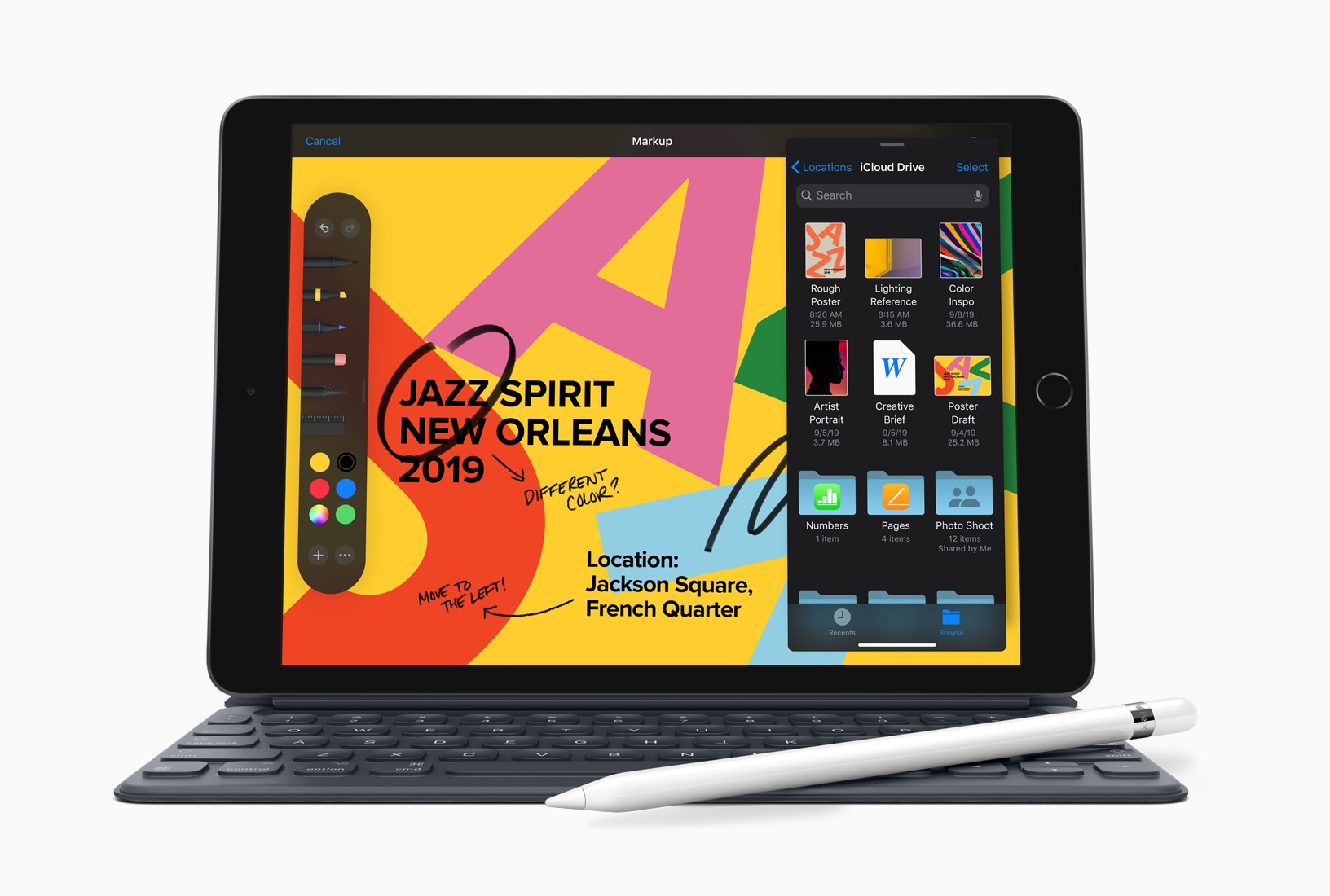
10.2-inch iPad
The first hardware of the day surprised me. Apple introduced a new entry-level 10.2-inch iPad replacing the $329 9.7-inch model.
The new iPad uses the A10 Fusion CPU from the iPhone 7, same as the outgoing 9.7-inch model. However, the new screen has been paired with a Smart Connector, so Apple’s foldable Smart Keyboard cover can be used with this iPad.
Like the out-going 9.7-inch, this iPad supports the first-generation Apple Pencil and has a Lightning port.
The elephant in the room is the 10.5-inch iPad Air, which also supports the Smart Keyboard, Apple Pencil. The iPad Air starts $499 for a Wi-Fi model with 64 GB of storage, a big jump from $329, even if that entry-level iPad has just 32 GB of storage.
For the additional money, the iPad Air comes with:
A slightly larger display that is laminated and has an anti-reflective coating
Support for P3 wide color
True Tone support
A storage ceiling of 256 GB (instead of 128 GB on the plain iPad)
Better cameras
The much-faster A12 Fusion chipset
So, is the iPad Air worth the upgrade in price? I think so, but I don’t think anyone walking into an Apple Store will understand that, as they look the same, support the same accessories and are practically the same size. Yes, the screen on the Air is a lot nicer, and it’s a lot faster, but is that enough?
Apple Watch Series 5
Going into this event, very little was known about the next Apple Watch, and it turns out, this year is mostly about improving the performance of the Watch, with the exception of one big feature: an always-on display.
For the first time, someone wearing an Apple Watch will be able to tell the time without turning their wrists or tapping their Watch. Apple has achieved this by tinkering with the display and the hardware that drives it, while still claiming all-day battery life.
Another big feature, in my mind at least, is that Apple is uncoupling the Watch and band when you purchase. As always, they have suggested pairings, but now ordering a different band at the time of purchase is super simple. I think a lot of people ended up with spare bands they did not want, and this should help with that.
The Series 5 looks the same as the Series 4, with its larger screen and slimmer case, but this year Apple has a couple of new case options, including brushed titanium and the return of the ceramic Apple Watch. These models have been branded “Apple Watch Edition,” a name I did not think we’d ever see again.
Here’s some fancy marketing copy from Apple:
Titanium is one of the most sought-after materials in the watch world. It’s 45 percent lighter than stainless steel, yet has twice the strength to weight ratio. For the natural brushed titanium finish, Apple invented a whole new surface treatment that is stain and fingerprint resistant to keep it looking immaculate. The space black titanium finish uses a diamond-like coating, making it both beautiful and incredibly durable.
aaaaand:
Ceramic makes a return to Apple Watch. Sleek, light, and extremely durable, it’s more than four times as hard as stainless steel — with a pure, white finish that won’t scratch or tarnish. Every ceramic case is compression molded, sintered, and polished to a striking shine with a diamond slurry, a process that takes days.
Both options look great, but are more expensive than the stainless steel Apple Watch, starting at $799 for the Titanium and $1,399 for the ceramic.
The Series 3 is hanging around at a starting price point of $199.
As for me, I’m going to be sitting this Apple Watch revision out. I have a Series 4 that I wear when working out, but I’ve moved on from the Apple Watch in day-to-day use.
iPhone 11
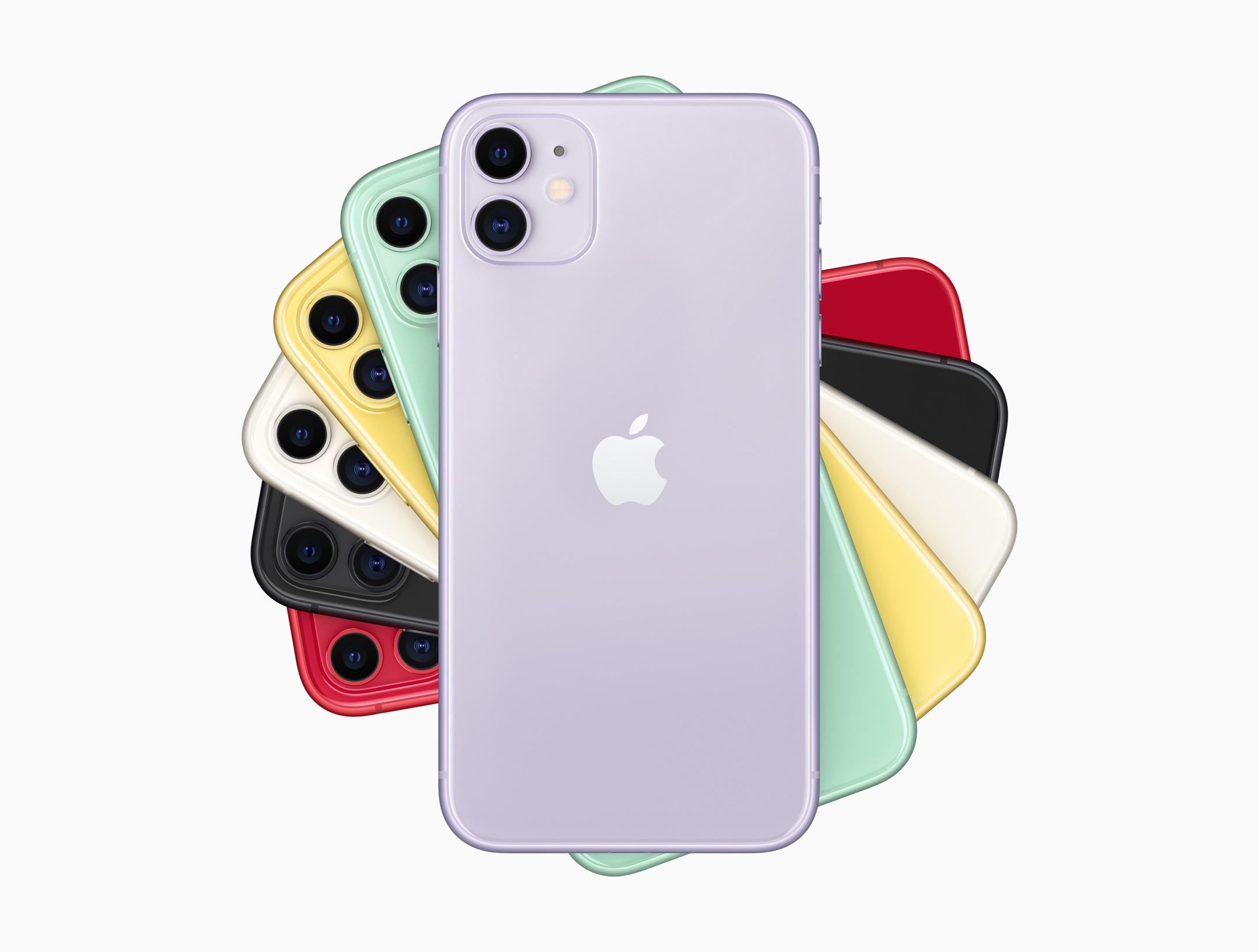
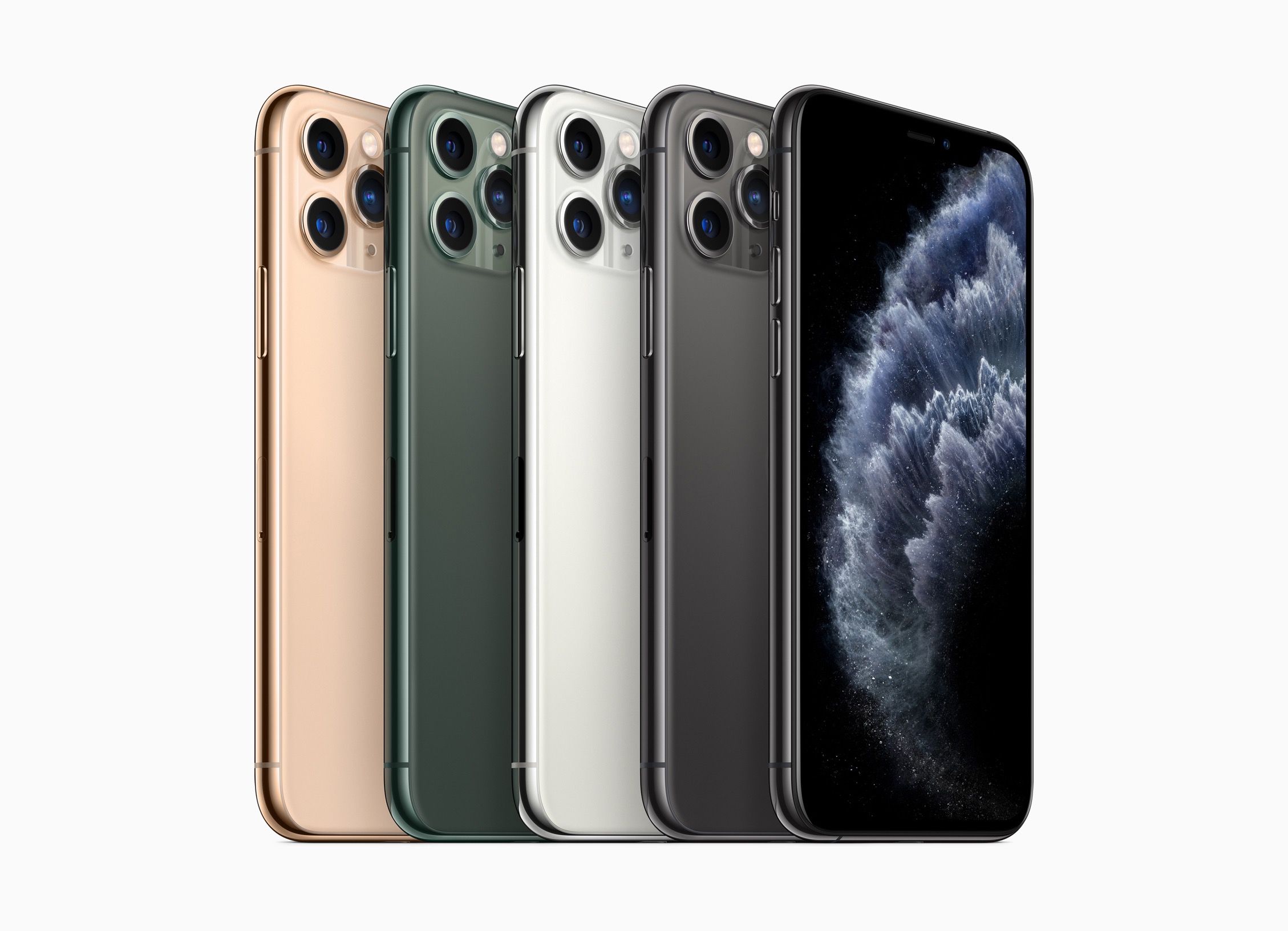
As rumored, the old iPhone XR has become the mainstream iPhone, this time called the iPhone 11. Like last year, it is built around a 6.1-inch LCD screen complete with Face ID and comes in a bunch of colors:
On the inside, Apple has followed in last year’s footsteps as well, making the iPhone 11 and its more expensive siblings all powered by the same A13 Bionic chip.
Around back, the 11 has picked up a second camera. The new ultra-wide camera shoots 12MP images through a 5-element, 13mm lens with a 120 degree field of view. I think it’s going to be a lot of fun.
Going into this cycle, I had assumed the rumored ultra-wide lens would the third camera on the back of the more expensive phones, with the telephoto trickling down to the 11. I was wrong; this new phone has the same new ultra-wide shooter as the other two phones, which boast being the only models with the telephoto option.
Clearly, Apple thinks more people will use the ultra-wide than the telephoto, but the lack of the telephoto option was the one feature that made the iPhone XR unusable for me. Perhaps I’m just in the minority, but being able to zoom in is important to me.
Battery life this year is up one hour over the iPhone XR, and water resistance on the iPhone 11 is rated for a depth of 2 meters for up to 30 minutes.
The iPhone 11 is a correction for Apple, realigning the product line to how customers thought of it, and the iPhone 11’s new price of $699 is a reflection of that. I suspect this phone will sell very well to people still holding onto an iPhone 6S or 7.
iPhone 11 Pro
The replacement for the iPhone XS introduces a new name to the iPhone line — Pro. On stage, Phil Schiller said that names means that Apple believes that high-end users can get all their work done with the product. That aside, I think the name makes sense within Apple’s universe.
The bigger phone being named the iPhone 11 Pro Max is bad, though. So, so bad.
The new phones match the old in terms of size, but the rear glass has now been treated to have a matte finish, and a new color has been added — Midnight Green.
When I saw the color, I thought of the Newton, but according to people on Twitter, it’s a popular color in China.
The iPhone 11 Pro picks up the same CPU and GPU performance gains at the 11 thanks to the A13 chip, as well as the new ultra-wide camera. Apple showed how video recording can be handed off between the various cameras without any change in color, temperature or focus, which is really impressive.
Both the 11 and 11 Pro are picking up new Night Mode, which is long overdue. Google and others have been out in front here for a while.
Like the 11, these devices see a jump in battery life: 4 hours from the iPhone XS to the 11 Pro, and 5 from the XS Max to the 11 Pro Max. All of this is despite a much brighter “Super Retina XDR Display” which can now max out at 1,200 nits.
One thing missing from the keynote was the rumored Apple Tags, but Apple’s website seems to point in their direction:
The new Apple‑designed U1 chip uses Ultra Wideband technology for spatial awareness — allowing iPhone 11 Pro to precisely locate other U1‑equipped Apple devices. It’s like adding another sense to iPhone, and it’s going to lead to amazing new capabilities.
With U1 and iOS 13, you can point your iPhone toward someone else’s, and AirDrop will prioritize that device so you can share files faster. And that’s just the beginning.
Something else that doesn’t appear on any of the new phones? A USB-C port, or 3D Touch. Apple is using Haptic Touch across the board now. As this gives every phone and the iPad a more consistent experience, I’m mostly okay with the loss of 3D Touch.
What’s Next
Apple has some unfinished business this year, especially in terms of Mac hardware, so I expect to see another event in October. With a messy software release schedule, the company is clearly playing catch-up in some areas, so October may be a nice change to demo some of the iOS 13 features that will be missing when customers unbox their iPhones next week.
Even with iOS 13 being a bit of a mess, I’m excited to check out the 11 Pro next week. That ultra-wide camera should be a lot of fun, and I am looking forward to seeing better battery life from my iPhone. The XS hasn’t been great in that regard for me.
Speaking of videos, don’t miss this fun story about Apple’s event recap video… ↩︎
One of Apple’s most iconic Apple Stores, the all-glass cube on Fifth Avenue, has been under renovations since 2017. Last week, Apple revealed a new look for the cube that makes it shine with a rainbow iridescence — and we sent our photographer Amelia to capture it for you.
The new look is gorgeous, but also not permanent. Apple told The Verge that the iridescence is caused by a wrap covering the glass that is “temporary,” so see it while you can.
That’s a shame — the glass cube looks stunning with this colorful sheen:
If toast always lands butter-side down, and cats always land on their feet, what happens when a cat falls off a table with a piece of toast strapped to its back?
My thanks to our sponsor:
Moo: Custom business printing and design. Save 15%.
The Chandrayaan-2 lander seems to have met its end on the lunar surface as SpaceX inches forward with its Raptor testing program. Then, NASA’s plans for commercial lunar landers and how the agency prepares Kennedy for hurricanes.
Got this one in under the wire before the iPhone keynote blows up the rest of the week. SPACE NEWS DESERVES ITS OWN TIME, TOO.
My thanks to our sponsors:
ExpressVPN: High-Speed, Secure & Anonymous VPN Service. Get 3 months free with a 1-year package.
Squarespace: Make your next move. Enter offer code LIFTOFF at checkout to get 10% off your first purchase.
This week on MPU, David and I talked through the various ways one can backup their Apple devices:
Backing up our Macs, iPhones and iPads is easier than ever, but many people don’t bother making sure their data is safe and sound. David and Stephen talk through some basic backup strategies before offering some advice when considering upgrading to new versions of macOS and iOS.
If you aren’t backing up your data on a regular basis, this one is for you.
And no, syncing with Dropbox or iCloud is not a backup.
TextExpander from Smile: Get 20% off with this link and type more with less effort! Expand short abbreviations into longer bits of text, even fill-ins, with TextExpander from Smile.
Hover: Make a name for yourself. Get 10% off any domain name.
Squarespace: Make your next move. Enter offer code MPU at checkout to get 10% off your first purchase.
I remember watching this keynote at work in the conference room with several of my co-workers, and the news of two bigger iPhone was a big deal, but that section was only 36 minutes long. Everything felt rushed. Then, an hour in, we got to the Apple Watch.
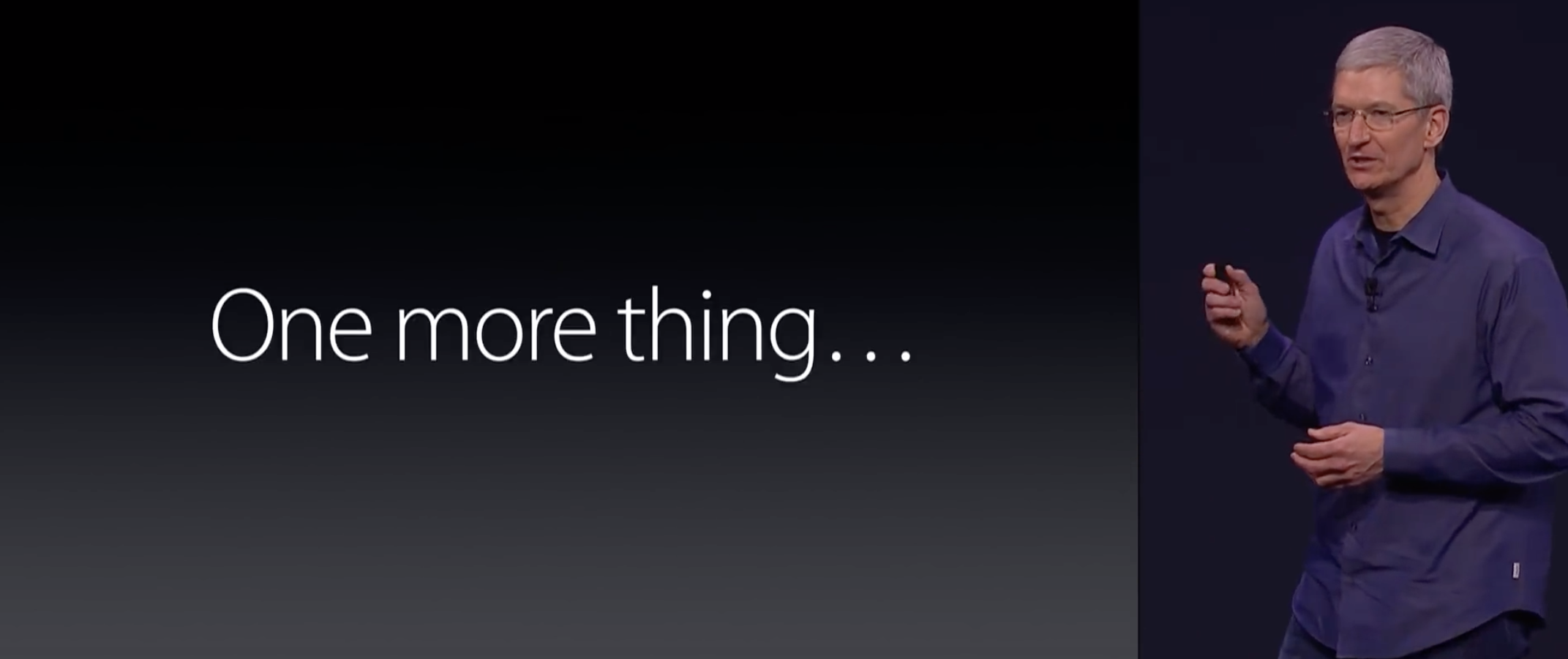
The segment opened with Tim Cook resurrecting an old Steve Jobs slide, as his voice broke announcing what he believed would be “the next chapter in Apple’s story.”
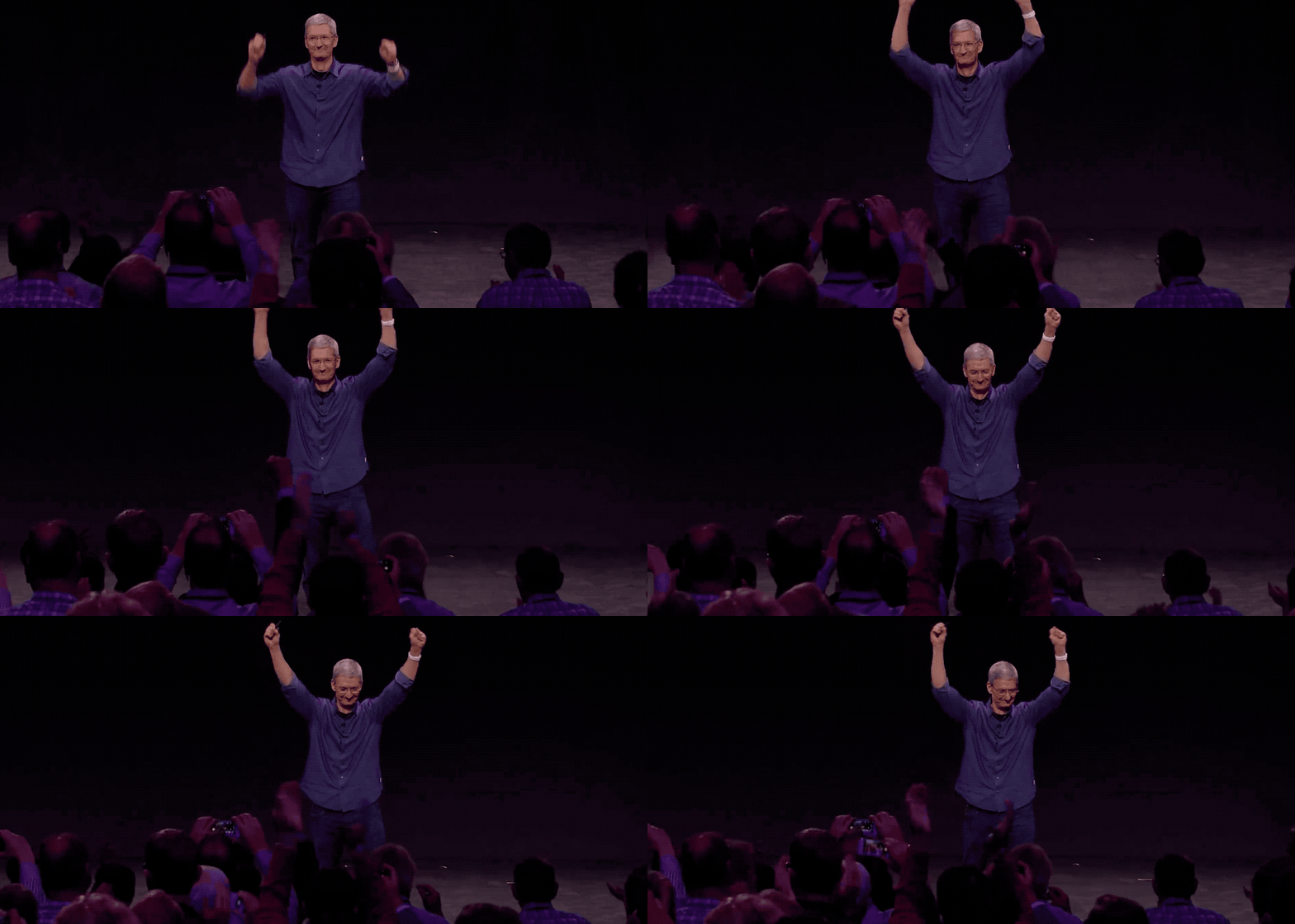
After an introductory video of swooping shots slowly revealing the Apple Watch, Tim Cook came back on stage to great applause. His sleeves were rolled up to show off what many believe to be the first new product under the post-Jobs Apple.
Cook was clearly emotional as he settled the crowd down for what would be a 50-minute announcement and walk-through of the device. The excitement in the room can still be felt when watching the video five years later.
The way Cook introduced the Apple Watch is super interesting. Trying to recapture the “It’s a phone, it’s a widescreen video iPod, it’s an Internet communicator!” bit from the original iPhone announcement, Cook walked the audience through the central tenants of the Apple Watch:
A precise, customizable timepiece
An intimate way to connect and communicate
A comprehensive health and fitness companion
Needless to say, all of that didn’t really roll off the tongue like Jobs’ repeated mantra from 2007, but Cook kept going, introducing the Digital Crown, putting it in the same Input Device Hall of Fame as the Macintosh’s mouse, the iPod’s click wheel and the iPhone’s Multi-touch display — again, echoing the Macworld 2007 keynote.
At the time, this really jumped out to me. 2014 Apple was clearly trying to channel 2007 Apple, and for good reason: Jobs’ iPhone keynote is perhaps the best product announcement of all time. The Apple Watch, the company was subtly saying, was going to be a big deal.
After showing off the basics of the UI and the Digital Crown, Cook leaned into the fashion angle of the Watch, praising the Apple Watch’s looks, before playing a Jony Ive video about the device’s design.
This 10 minute video introduced key features, including Raise to Wake, several of the built in apps and the inclusion of Siri.
Digital Touch was a huge deal in this early version of the Apple Watch’s software. The side button launched a list of your friends1, allowing you to sketch a little design to them or send your heartbeat. I wrote this about Digital Touch in my original Apple Watch review:
With Digital Touch, you can doodle a little picture to a friend, send a tap or — if you’re sure they won’t take it the wrong way — a representation of your heartbeat, which will play out via the Taptic Engine in their watch.
These communication methods are only available to people wearing an Apple Watch, and that may be why this hasn’t really taken off in my life. Sure, it’s funny to send Myke Hurley my heartbeat or draw a stick figure to Federico Viticci, but I’ve never used it to seriously communicate or get someone’s attention with a tap.
I suspect that I might feel differently if my wife had an Apple Watch, but as she’s opposed to that, Digital Touch will remain a funny thing to do with friends, and not evolve into the private, intimate, communication method Tim Cook promised on stage.
As predicted, Digital Touch hasn’t really taken off for most users. In fact, the side button of the Watch now loads the Dock, not a circle of heartbeat-worthy friends and family.
The Ive video also walks through the technology that made the small device possible, including the Taptic Engine, Force Touch, heart rate sensor, gyroscope and more.
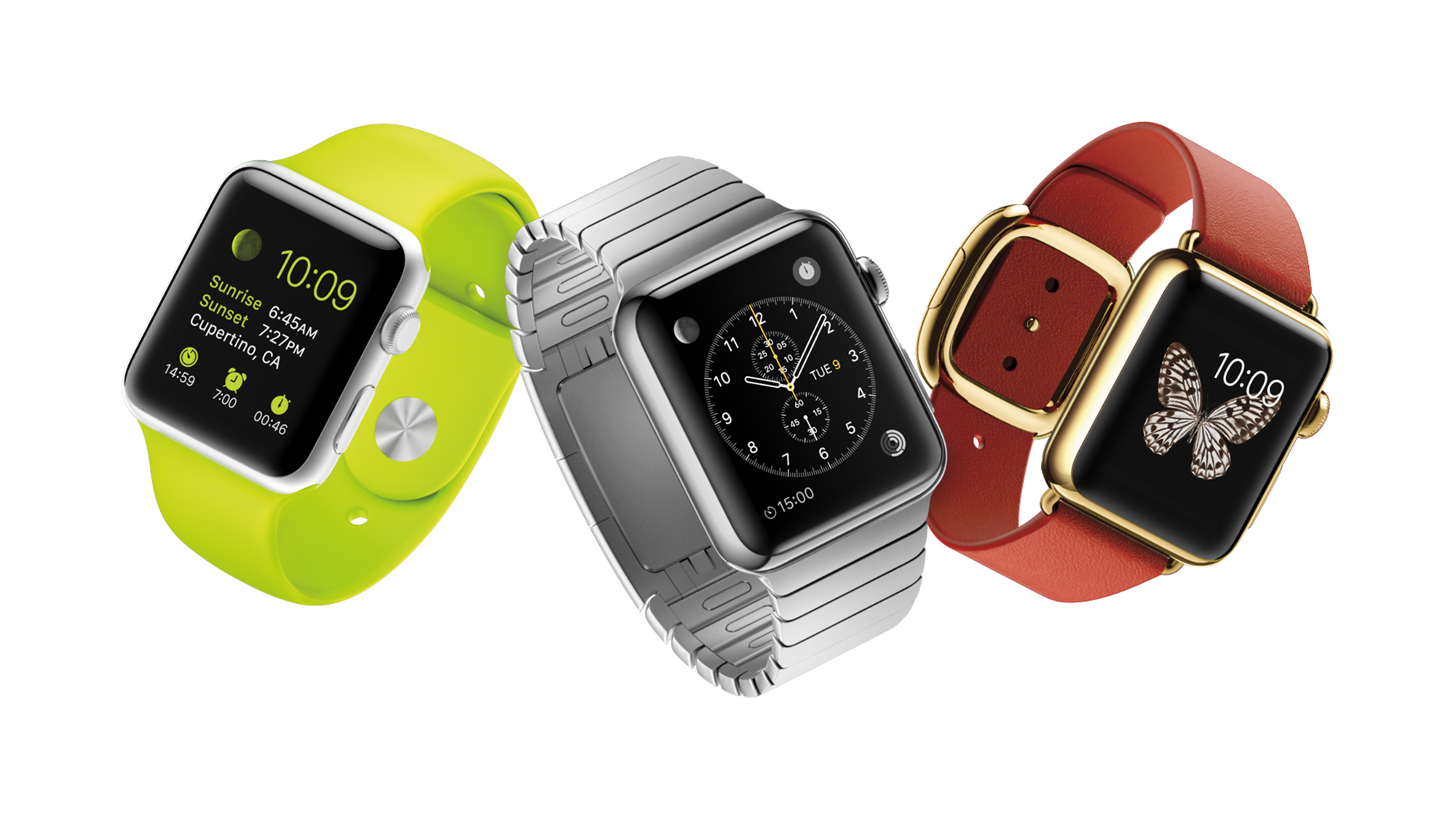
The three Apple Watch “collections” were also laid out in the video. It seemed that the stainless steel “Apple Watch” was thought of by Apple as the default option, complete with its sapphire screen. The aluminum “Apple Watch Sport” used hardened glass to cover the screen, and was assumed to be less expensive with its cheaper materials and less-fancy bands.
Then there was “Apple Watch Edition,” made of 18-karat gold. The world didn’t know about the $17,000 price tag for these models yet, but at the time, it sure felt out of line to many of Apple’s nerdy fans.
Apple Watch comes in three distinct collections—Apple Watch, Apple Watch Sport and Apple Watch Edition—available in two different sizes, 38 mm and 42 mm. The beautifully designed and durable enclosures are crafted from custom alloys of polished or space black stainless steel, space gray or silver anodized aluminum and 18-karat rose or yellow gold. Apple also created an entire range of watch straps: the high-performance elastomer Sport Band; the Milanese Loop in a flexible magnetic stainless steel mesh; the Leather Loop in soft, quilted leather that conceals magnets for quick fastening and adjustment; the leather Modern Buckle, which closes with a solid metal clasp; the leather Classic Buckle; and the stainless steel Link Bracelet. Apple Watch comes with a unique charging system that combines Apple’s MagSafe technology with inductive charging for a quick connection that snaps into place.
After Ive’s video wrapped up, Kevin Lynch took the stage for a lengthy demo of the Apple Watch’s software. He showed off the customizations available on the watch faces and bounced around between first and third-party apps.
Of course, some of the software features — like Glances — have simply gone away over time, but in re-watching this, I was surprised to see how much of watchOS is still the same as it was when announced.
It’s clear to me now that Apple initially thought of the Apple Watch as a smaller iPhone. Even though the WatchKit development tools were pretty hamstrung at first, Lynch pitched a future where just about anything you could do on your phone, you’d be able to do on your wrist.
As the Apple Watch has matured, so has Apple’s way of talking about it. Today, the Watch is sold as a fitness and communications device, with more general-purpose tasks best left to the phone, even as Watch apps have become more powerful.
Apple doesn’t share sales numbers, but it’s clear that the Apple Watch has done well, and its evolution over the last five years has been relentless. The Apple Watch is a lot faster, and a lot more useful, than it was at launch. That should not surprise anyone, but sometimes it’s fun to see how quickly things can change.
In this video, friends were shown off in a grid, but it was replaced by a circular UI by the time the Apple Watch shipped in 2015. ↩︎
This month’s Bloomberg Businessweek is dedicated — in its entirety — to the periodic table, which turns 150 this year. It’s really something.via Kottke